Whether in medicine, science, or technology, certain methods are considered the gold standard because they have proven to be the most accurate and dependable over time. This applies to the SAT/ACT to get into college, GPS Atomic Clocks, the Academy Awards – the gold standard in movies, peer-reviewed publications for medical journals, and in Parkinson’s disease, the MDS-UPDRS Movement Disorder Society Unified Parkinson’s Disease Rating Scale. It has long been the gold standard for measuring symptoms and disease progression since it made its debut in 2008.
The four-part test allows neurologists to measure many aspects of Parkinson’s disease. Part One includes tests for non-movement symptoms such as depression, anxiety, sleep problems, and other symptoms that can affect daily life. Part Two evaluates how movement symptoms of Parkinson’s disease affect daily routines such as eating, getting dressed, and handwriting. Part Three consists of the physical examination, during which the neurologist looks for tremor, rigidity, slowness of movement, balance, walking ability, and stability. Part Four evaluates complications that can develop from long-term Parkinson’s treatment, including involuntary movements (dyskinesias), medication wearing-off periods, motor fluctuations, and other medication-related issues. The benefits of the scale are to be able to accurately measure the condition of the patient, track how the effects of Parkinson’s disease change over time, evaluate how well treatments are working, and compare a patient’s progress from one visit to the next.
A company called NeuraLight may help to redefine at least part of this standard. Published in Springer Nature, NeuraLight’s objective was to see if eye-tracking movements could be used as a tool to track the progression of Parkinson’s disease, called Saccadic Hypometria ( suh-KAD-ik -hy-poh-MEE-tree-uh). A saccade is a rapid eye movement that shifts your gaze from one object to another. Normally, the eyes move directly to the target. In saccadic hypometria, the eyes don’t move far enough to reach the object you’re focusing on, stopping short of their target and having to make an extra movement to finish getting there. So researchers sought to track the sensitivity of this movement and whether it could be reproduced for use as a biomarker for tracking Parkinson’s disease progression using the MDS-UPDRS Part III. What are biomarkers? Simply put, a biomarker is a measurable indicator that reflects something happening in the body or brain that can’t easily be seen directly. If you can find something you can measure that is reliable, can be measured repeatedly, and objectively that tracks with what the disease is doing, that’s a biomarker.
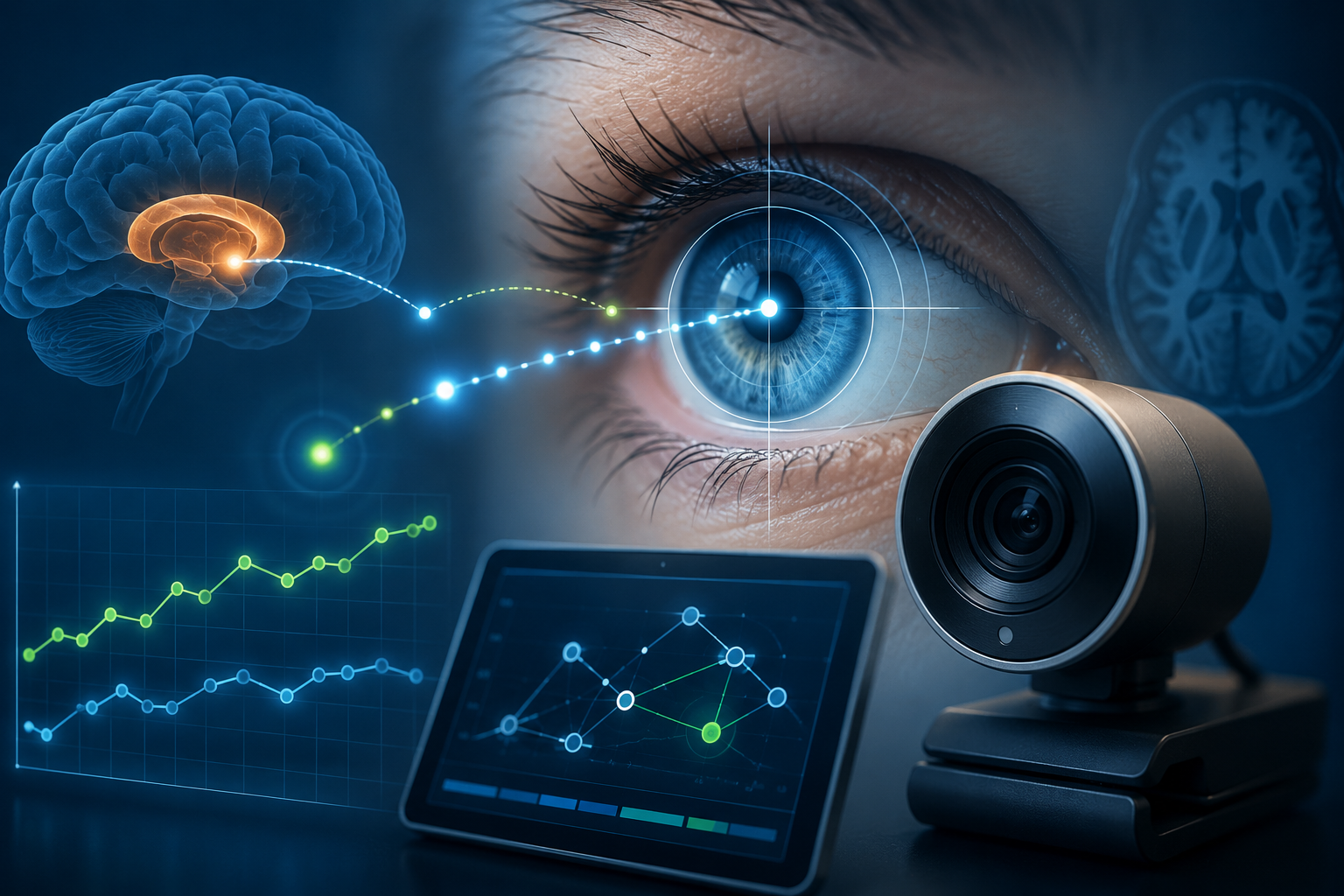
The first group of volunteers, which consisted of 30 patients with the most common form of Parkinson’s disease, known as idiopathic (not genetic), and 50 healthy control volunteers, were enrolled at the Tel Aviv Medical Center’s Movement Disorders Unit in Israel. The volunteers, ranging in age from 18 to 85, were evaluated every three months over a nine-month period of time. During each visit, they sat down in front of a computer screen and a webcam with eye tracking software developed by NeuraLight, Israel, watching visual targets as they appeared on screen, with a NeuraLight staff member guiding the participants as the test progressed. These consisted of Pro-saccades: looking directly at a target as soon as it appeared, Anti-saccades: looking in the opposite direction of a target, which requires more thinking and self-control, and Memory-guided saccades: relying on memory to look at a target’s previous location after it disappeared from view. There were approximately 200 total viewing targets throughout each session of the test. The software used the eye movement data from all of the tests to calculate a score called Amplitude of Saccadic Hypometria, or ASH, which measures how accurately the eyes reach a target. The 10-minute test requires a laptop with the software preloaded and a webcam, and can be done from any neurologist’s office without any expensive hardware involved, lessening the burden on patients during what are already demanding visits.
The second and larger phase of the study included 250 people between the ages of 40 and 85 years of age, who had a diagnosis of Parkinson’s disease for less than five years and were in the early stages of the disease, with 91 healthy volunteers also participating. These volunteers, like those in the Tel Aviv study, were evaluated every three months for nine months. These were carried out in four research centers located in the United States, Spain, Portugal, and the United Kingdom.
The results of NeuraLight’s study point out that using the traditional MDS-UPDRS scale failed to show any clear signs that progression of the disease was actually getting worse, in part because different physicians score patients differently from site to site, and because traditional methods don’t account for the influence of medications like Levodopa.
Scores did not worsen in healthy volunteers, suggesting the changes were caused by Parkinson’s disease rather than by normal aging. Researchers also found that the results matched up with the established Parkinson’s MDS-UPDRS motor assessments at the start of the study, providing additional evidence that the biomarker was measuring disease-related changes.
The software developed by NeuraLight is a brain function biomarker platform that derives biomarkers from eye movements. The software biomarker showed more consistent changes to a patient’s condition over time, detecting changes over the 9-month trial period. The MDS-UPDRS typically requires around 500 patients and two and a half years to detect meaningful change; the eye tracking biomarker needed only 300 patients and nine months to reach the same conclusions. If ASH is truly less affected by dopaminergic medications, it may provide a more objective way to measure the underlying progression of Parkinson’s disease rather than simply reflecting how well symptoms are controlled by treatment. Something else pointed out in the study was that the test picked up on cognitive functions as well as motor functions, making the possibilities of using this test even greater, giving neurologists an insight into how patients are progressing mentally. This allows them to assign additional therapies or medications at a point in the disease when early action can make the most difference.
The results of this study point to why the MDS-UPDRS may need to undergo some alterations in order to keep up with the growing technology that needs to evolve a combination of traditional clinical evaluations and digital biomarkers, allowing researchers and neurologists to detect changes that might otherwise go unnoticed.
As with all clinical studies, there are limitations to each study. For this one, NeuraLight points out that all participants had early-stage Parkinson’s disease and were all taking medication, so those who have more advanced features and those not receiving treatment, the results may not apply. They also point out that the study followed patients for only nine months, making it too soon to know whether the eye-tracking biomarker can predict long-term disease progression. Researchers also did not account for factors such as fatigue, stress, or alertness, which could have influenced performance during testing. Additional studies with larger and more diverse patient populations and longer follow-up periods are needed to confirm the findings.
The study, published in the peer-reviewed Springer Nature journal Pharmaceutical Medicine, found the consistency of results across four countries and two separate patient groups makes the research compelling for independent researchers who will want to explore further.
Additional larger phases of this trial could bring these digital biomarkers to the forefront of tracking the progression of Parkinson’s disease, offering a new way to measure changes that may not be captured by traditional clinical assessments alone.
You can learn more about NeuraLight by visiting their website here.
Correction: the paper published by NeuraLight has been peer reviewed. Apologies to NeuraLight for the misinformation.

Image by Chris Denny and ChatGPT
Discover more from
Subscribe to get the latest posts sent to your email.