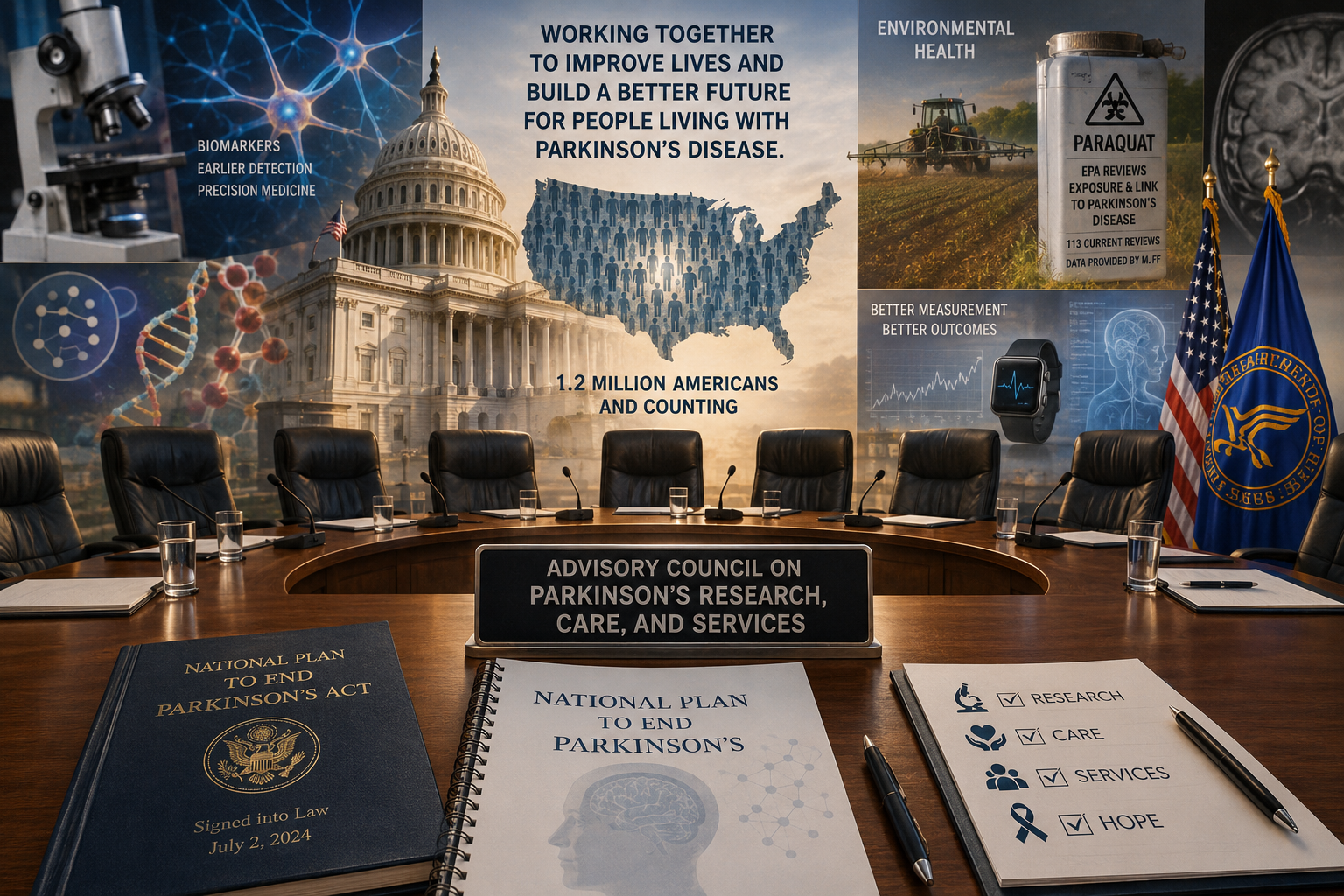
Today marks what may be a historic occasion in the history of Parkinson’s disease research and support for the 1.2 million Americans living with the disease. The Advisory Council on Parkinson’s Research, Care, and Services, known as ACPRCS, was established by the National Plan to End Parkinson’s Act of 2024. The council will make recommendations to the Secretary of Health and Human Services to help develop a national plan guiding care, funding, and research. Its inaugural meeting brought together a diverse group of patient advocates, clinicians, researchers, and federal health leaders who will help shape the nation’s first National Plan to End Parkinson’s.
The National Plan to End Parkinson’s was signed into law on July 2, 2024, by President Joe Biden. It established the first federal framework dedicated to creating a pathway for patients, caregivers, researchers, and policymakers to work toward common goals, all aimed at improving the lives of those affected by Parkinson’s disease. Today, that framework takes its first concrete step. The ACPRCS is modeled after a similar council established under the National Alzheimer’s Project Act, bringing together federal officials and outside experts to advise the HHS Secretary on developing a coordinated national strategy.
The non-federal members bring a wide range of expertise. They include Deborah W. Brooks, CEO and co-founder of the Michael J. Fox Foundation; neurologists Bradley F. Boeve of Mayo Clinic, Alice Chen-Plotkin of the University of Pennsylvania, Michael S. Okun of the University of Florida Health, and David G. Standaert of the University of Alabama at Birmingham; Cathi-Ann Thomas, a nurse and program director at Boston University Medical Campus; Jessica Shurer, Director of Clinical Affairs and Advocacy at CurePSP; Jessi Keavney, a caregiver advocate and patient research partner who carries the LRRK2 genetic variant linked to Parkinson’s; Israel Robledo, a patient advocate diagnosed with Parkinson’s 19 years ago; and Sara Whittingham, a physician, Air Force veteran, and patient advocate diagnosed with Parkinson’s at age 46.
The federal members represent agencies spanning research, regulation, veterans’ care, and public health. They include Amy Bany Adams, PhD, Acting Director of NINDS; Nancy Beck, PhD, Principal Deputy Assistant Administrator at the EPA’s Office of Chemical Safety and Pollution Prevention; Maria Bellantoni, MD, geriatrician at the Phoenix Indian Medical Center and IHS Chief Clinical Consultant for Geriatrics and Palliative Care; Leslie Beltran, PhD, Program Manager for the Parkinson’s Research Program at the Congressionally Directed Medical Research Programs; Teresa Buracchio, MD, Director of the Office of Neuroscience at the FDA; John Duda, MD, National Director of the VA’s Parkinson’s Disease Research, Education and Clinical Centers; Stephanie Haridopolos, MD, Principal Deputy Assistant Secretary for Health; Roger Klein, MD, JD, representing the Agency for Healthcare Research and Quality; Gayathri Kumar, MD, Chief Medical Officer of the HHS Office of Minority Health; Mary Lazare, Principal Deputy Administrator of the Administration for Community Living; Shari Ling, MD, Deputy Chief Medical Officer at the Centers for Medicare and Medicaid Services; Edda Thiels, PhD, Program Director at the National Science Foundation; and Francisca Abanyie, MD, MPH, Acting Principal Deputy Director of the Office of Science at the CDC.
The council’s inaugural meeting opened with welcoming remarks from Dr. Amy Bany Adams, Acting Director of NINDS and chair of the ACPRCS, before Dr. Jordan Gladman, the council’s Designated Federal Official, called the body to order and oversaw member introductions. The morning continued with an orientation to the council’s charter and charge, followed by the first of two sessions in which federal members outlined existing Parkinson’s programs across their agencies.
Among the strongest research themes to emerge from the meeting was a growing emphasis on biomarkers and the push to accelerate new medical products. NIH officials outlined efforts to improve diagnostics, identify biological markers that can detect Parkinson’s earlier or track its progression, and move promising discoveries more efficiently from the lab into clinical practice. The presentations also pointed to the expanding role of precision medicine — part of a broader shift toward recognizing that Parkinson’s may not be a single disease but a collection of biological subtypes that affect patients differently. These priorities are already shaping research across the Parkinson’s community. That they were returned to repeatedly during the council’s first meeting suggests they will remain central to federal planning going forward.
Environmental health drew significant attention as well. The EPA walked council members through its role in evaluating environmental factors tied to Parkinson’s disease, pesticide exposure, toxicology, exposure science, and chemical risk assessment. Among the topics was paraquat, the herbicide that has attracted growing scrutiny over research examining possible links between long-term exposure and Parkinson’s. In 2022, the EPA prohibited the use of mechanically pressurized handgun and backpack sprayers and limited aerial spraying. There are currently 113 active reviews examining exposure and its link to Parkinson’s disease, with data provided by the Michael J. Fox Foundation. Officials described how the agency weighs epidemiological studies, laboratory research, animal studies, and exposure data as part of its pesticide registration review process. The presentation announced no new regulatory actions involving paraquat or other chemicals. It was, by design, an orientation — giving council members a clearer picture of how environmental evidence moves through the federal regulatory framework. That context matters, as environmental risk factors are drawing increasing attention from researchers, advocates, and lawmakers around the world.
The meeting also turned to how Parkinson’s disease is measured and whether current tools are keeping pace. FDA officials highlighted work on clinical outcome assessments, including continued development involving the Movement Disorder Society-Unified Parkinson’s Disease Rating Scale, or MDS-UPDRS, the gold standard for evaluating Parkinson’s symptoms in clinical trials. The discussion reflected a broader recognition that as digital biomarkers, wearable technologies, and artificial intelligence enter the research landscape, the instruments used to track disease progression need to evolve alongside them. No specific changes to the MDS-UPDRS were announced. But its appearance in the FDA’s presentation was itself notable, a signal that how Parkinson’s progression is measured remains an active consideration in federal thinking about future drug development.
Much of the afternoon centered on a question that will define the council’s work going forward: how to translate a broad federal mandate into specific, actionable recommendations. Dr. Bany Adams led the discussion, which touched on how to address patient care needs, how to balance care with enhanced services, and what individual members hoped to accomplish as they worked toward improving quality of life for patients, caregivers, and researchers alike. Dr. Okun pushed for sharper focus, calling on the council to define concrete goals rather than defaulting to broad aspirations. Among the priorities that emerged was the need to grow the pipeline of neurologists and others involved in Parkinson’s research and care.
This broad landscape review carried through lunch and into the early afternoon. Dr. Bany Adams then led the council through a discussion of its goals and principles, followed by a presentation on the work plan from Dr. Sara Dodson of NINDS. After a short break, the floor opened for public comment before the meeting closed with next steps and action items.
Advocacy organizations, including the American Parkinson’s Disease Association, the Michael J. Fox Foundation, and the Parkinson’s Foundation, had been pressing HHS to formally seat the council and meet its federally mandated timelines. That makes today’s inaugural meeting a meaningful milestone, not just a ceremonial one. Even so, questions remain about how seriously the current administration will take the council’s work and how much it will ultimately be able to accomplish given the climate in Washington.
The National Plan to End Parkinson’s Act gives the ACPRCS no authority over the federal budget. The council can recommend, prioritize, and advise, but it cannot direct funding. Any money needed to act on its recommendations still has to be approved by Congress through the regular budget process, and research grants continue to flow through existing agency channels such as NINDS. How much influence the council will carry, and how many in Congress are listening, remains to be seen.
There are a lot of hopes riding on this newly formed committee. First steps are always challenging, especially when the task is as ambitious as creating a national plan to address a complex disease like Parkinson’s.
Names and photos of both federal officials and non-federal committee members can be found here
Discover more from
Subscribe to get the latest posts sent to your email.