Pip: Welcome to The Movement Disorder Journal and News — where the science of how the brain rewires itself turns out to be considerably more interesting than the phrase “cognitive decline” suggests.
Mara: Today we’re looking at research on how thinking changes in Parkinson’s disease, and the new mapping tools researchers are using to track it. Chris Denny covers the territory. Let’s start with what those tools are actually showing.
New Technology Maps How Thinking Changes in Parkinson’s Disease
Pip: The central question here is whether cognitive decline in Parkinson’s is really just a slow, even fade — or whether the brain is doing something more complicated, actively reorganizing as the disease progresses.
Mara: The study behind this comes from npj Parkinson’s Disease, and it sets up the framework directly: “The dual-syndrome hypothesis of cognitive impairment in PD postulates two distinct but overlapping paths of cognitive decline in PD: an early-onset fronto-striatal impairment, and a later-onset cholinergic-modulated posterior and temporal lobe impairments showing as language, memory, and visual-spatial dysfunctions, with more rapid decline to PDD.”
Pip: So the upshot is that decline doesn’t hit everything at once — attention and planning may slip earlier, while memory, visual thinking, and dementia-related symptoms follow a separate, later trajectory.
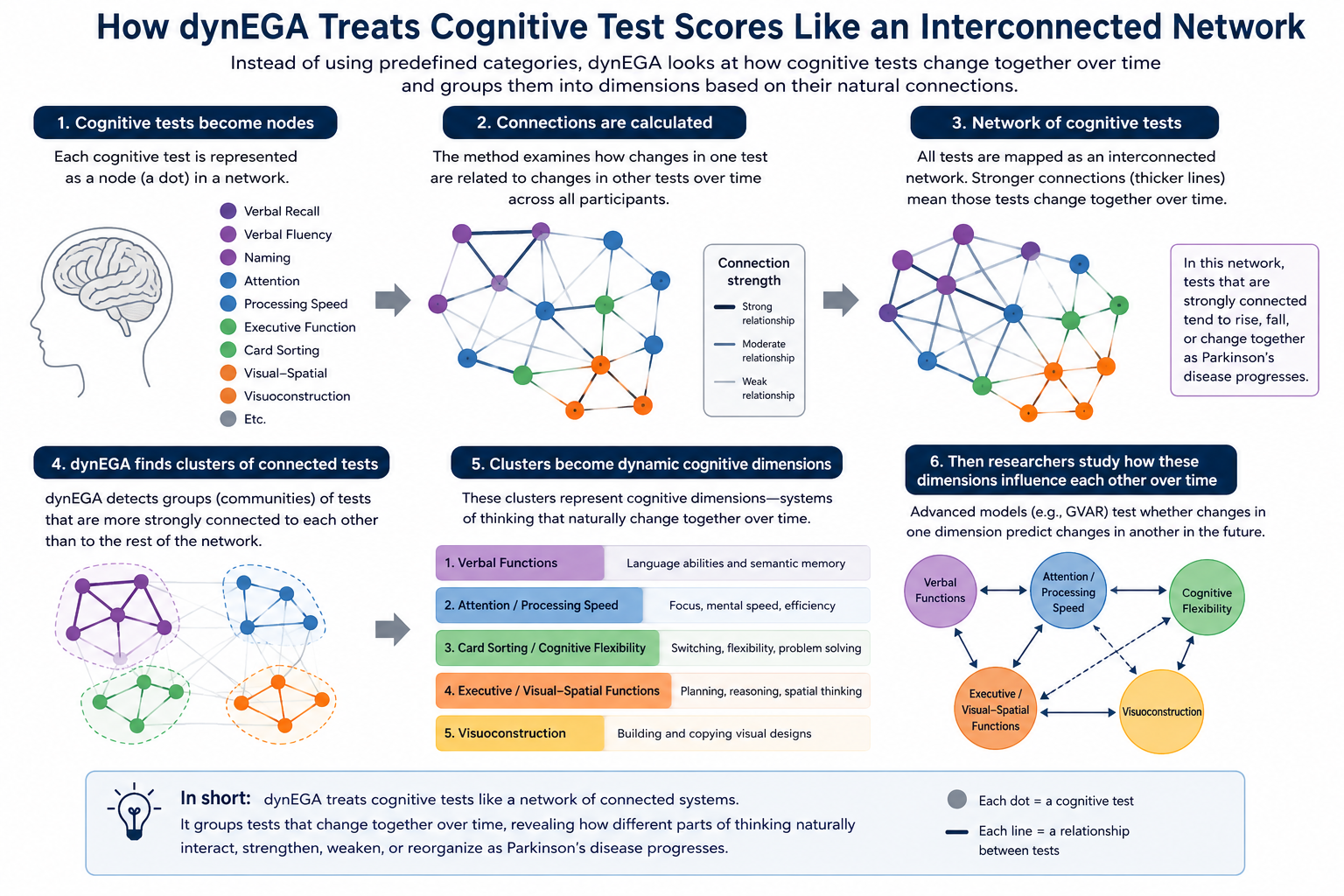
Mara: Right, and the tools used to surface that are genuinely novel. Researchers analyzed more than 24,000 cognitive data points from 355 people with Parkinson’s over four years, using Dynamic Exploratory Graph Analysis — dynEGA — to map how cognitive skills cluster and shift together, and Panel Graphical Vector Autoregression models to track how changes in one area predict changes in another over time.
Pip: Naming your analytical framework after a science-fiction weapons system does set a high bar for the findings.
Mara: The findings do hold up. Five distinct cognitive dimensions emerged — visuoconstruction, executive and visual-spatial functions, cognitive flexibility, attention and processing speed, and verbal functions. Attention and processing speed tended to move together; changes in language were linked to later shifts in problem-solving and visual-spatial thinking.
Mara: The study also challenges current diagnostic standards directly: “Our findings call into question the reliability and validity of widespread guidelines for cognitive diagnostics based on cognitive domains, such as the MDS guidelines for assessment of PD-MCI.”
Pip: Meaning the standard categories may be too rigid to capture what the brain is actually doing as Parkinson’s progresses.
Mara: The researchers also note that this kind of temporal mapping could extend beyond Parkinson’s — they specifically flag Alzheimer’s disease as a candidate for the same approach.
Pip: The same framework that maps cognitive reorganization in Parkinson’s could eventually tell us something about how other neurodegenerative diseases unfold — that’s a significant reach.
Mara: The throughline today is that Parkinson’s cognition is more dynamic than a straight decline — the brain adapts, reorganizes, and follows distinct pathways.
Pip: And the tools to see that are only just arriving. Next time, more from the journal.
Discover more from
Subscribe to get the latest posts sent to your email.