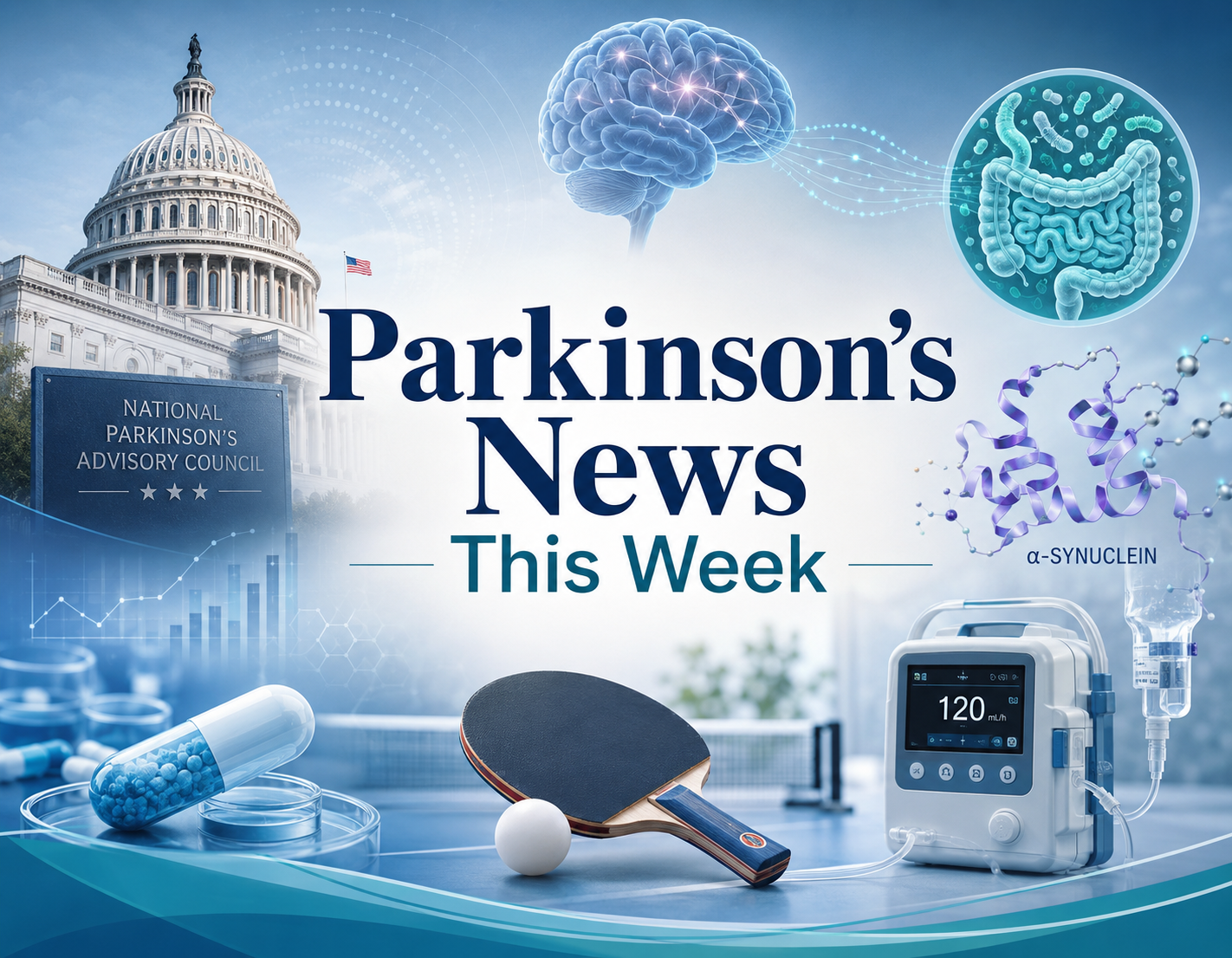
The past week brought no major Parkinson’s drug approval or decisive late-stage clinical trial result, but several developments offered a closer look at where research, treatment and federal planning may be heading. The news ranged from the next meeting of the federal Parkinson’s advisory council to preliminary findings involving an experimental oral drug. Researchers also published new work examining table tennis as a form of rehabilitation, the use of apomorphine infusion for advanced Parkinson’s and the structure of a genetic form of alpha-synuclein.
Federal Parkinson’s advisory council schedules second meeting
The federal government’s Advisory Council on Parkinson’s Research, Care, and Services will hold its second meeting Aug. 24, according to a notice published Tuesday in the Federal Register. The virtual meeting will run from 10 a.m. to 4 p.m. Eastern time and will be free and open to the public. The agenda includes presentations from nonprofit organizations focused on Parkinson’s and related disorders, a discussion of an inventory of federal Parkinson’s programs, and progress reports from the council’s subcommittees. The council was established under the Dr. Emmanuel Bilirakis and Honorable Jennifer Wexton National Plan to End Parkinson’s Act, which became law in 2024. Its members are charged with advising the Secretary of the U.S. Department of Health and Human Services on Parkinson’s research, treatment, care and support services. Written public comments must be submitted by 5 p.m. Eastern time Aug. 10 to be provided to council members before the meeting. A limited number of people will also be selected to present two- to three-minute summaries of their comments during the virtual session. Although the meeting announcement does not represent a new scientific finding, the council’s work could influence federal Parkinson’s research priorities and help identify gaps in care and patient services.
Gain Therapeutics reports early rexaceract findings
Gain Therapeutics also released an operational update on rexaceract, formerly known as GT-02287, an experimental oral treatment being developed for Parkinson’s disease. Rexaceract is designed to improve the function of glucocerebrosidase, an enzyme involved in the lysosome, the cellular system responsible for breaking down and recycling waste. Reduced glucocerebrosidase activity is closely associated with mutations in the GBA1 gene, one of the strongest known genetic risk factors for Parkinson’s. Researchers are also studying whether problems involving the enzyme may contribute to Parkinson’s in some people who do not carry a GBA1 mutation. Gain said all 16 participants who entered the open-label extension of its Phase 1b study remained in the study through Day 150, or about five months. An independent data monitoring committee reviewed the study July 6 and recommended that it continue without changes. The company characterized the participants as “non-progressors” at three and five months based on measurements of motor symptoms and activities of daily living. Gain also reported reductions in glucosylsphingosine, a biomarker associated with impaired glucocerebrosidase activity, among participants who had elevated when the study began.The findings remain preliminary and should be interpreted cautiously. The study is small, does not include a placebo group and is open-label, meaning the participants and researchers know the experimental treatment is being administered. Without a randomized comparison group, researchers cannot determine whether changes were caused by rexaceract, the natural variability of Parkinson’s symptoms, medication effects or other factors. The company plans to begin a larger Phase 2 trial in the United States, Europe and Australia during the third quarter of 2026. That study will offer a more meaningful test of whether rexaceract produces measurable clinical benefits or affects the progression of Parkinson’s disease.
Table tennis tested as Parkinson’s rehabilitation
A pilot study published July 15 examined whether a table tennis-based rehabilitation program could be a practical and engaging form of exercise for people with Parkinson’s. The study enrolled 30 participants, with 26 completing a 12-week program called NeuroPong. Participants attended two-hour table tennis sessions twice a week. Table tennis combines aerobic activity with hand-eye coordination, balance, rapid visual processing, movement planning and repeated changes in direction. Those demands make it an activity of interest for researchers studying neurological rehabilitation. Researchers examined attendance, retention and safety, as well as possible changes in motor and nonmotor symptoms. Assessments included the Movement Disorder Society-Unified Parkinson’s Disease Rating Scale and tests involving balance, mobility and cognitive function. The research was a single-arm pilot study, meaning every participant received the intervention and there was no control group for comparison. The findings therefore cannot establish that table tennis is more effective than other forms of exercise or rehabilitation. The study was primarily intended to determine whether the program was feasible and showed enough promise to justify a larger controlled trial.
Experts examine the underuse of apomorphine infusion
Another new publication focused on continuous subcutaneous apomorphine infusion, a treatment used to manage motor fluctuations in some people with advanced Parkinson’s. The expert review of apomorphine and other device-assisted treatments examined why apomorphine infusion remains underused despite evidence supporting its effectiveness in appropriately selected patients. Apomorphine stimulates dopamine receptors and can be delivered continuously through a small pump connected to a needle placed under the skin. The treatment may help reduce “off” periods when oral Parkinson’s medications are no longer providing consistent symptom control. The authors identified several barriers to wider use, including delays in referring patients for advanced treatment, uncertainty about patient selection, difficulties beginning the therapy and concerns about operating and maintaining the infusion system. The review called for better education, clearer referral pathways and improved support for patients and health care professionals during treatment initiation. Apomorphine infusion is one of several device-assisted treatment options for advanced Parkinson’s. Others include deep brain stimulation and continuous levodopa infusion. The most appropriate option depends on a patient’s motor symptoms, cognitive health, medical history, treatment goals and ability to manage the equipment. The publication was an expert review rather than a new clinical trial, but it adds to the continuing discussion over when patients should be evaluated for advanced treatments.
Study examines inherited alpha-synuclein mutation
Researchers also published new structural findings involving A30P alpha-synuclein, a genetic mutation associated with inherited Parkinson’s disease. Alpha-synuclein is a protein that can misfold and join together to form fibrils. Abnormal accumulations of the protein are a major component of Lewy bodies, one of the pathological hallmarks associated with Parkinson’s. In the A30P alpha-synuclein study, researchers prepared fibrils in a laboratory and examined their molecular structure. They found that the fibrils formed an organized structure known as a Greek-key fold. The structure resembles forms of alpha-synuclein considered relevant to disease, suggesting that the A30P mutation does not prevent the protein from developing a stable and potentially harmful fibril arrangement. The findings could help scientists better understand how inherited mutations influence alpha-synuclein folding, accumulation and stability. The research remains basic structural biology. It does not provide evidence for a new treatment or produce an immediate change in patient care.
Review connects gut bacteria, nanoparticles and Parkinson’s
A separate scientific review examined interactions among gut bacteria, nanoparticles and the gut-brain axis. Researchers have increasingly investigated whether changes in the intestinal microbiome may influence inflammation, alpha-synuclein accumulation or communication between the digestive system and the brain. Nanoparticles are also being studied as possible tools for delivering medications to specific tissues, crossing biological barriers or altering processes connected to inflammation and neurodegeneration. The authors proposed what they called a nanomaterial-microbiome-brain interface, bringing those areas of research together in a single conceptual framework. The review discussed potential future treatment strategies, but it did not provide clinical evidence that a nanoparticle-based therapy can prevent, slow or treat Parkinson’s in patients.
A week of incremental developments
Taken together, the week’s developments reflect the wide range of work underway in Parkinson’s disease. Federal officials are continuing to build the structure for a national Parkinson’s strategy. Researchers are preparing larger trials of experimental treatments, exploring new approaches to rehabilitation and examining how existing advanced therapies could reach more patients. At the same time, laboratory scientists continue to investigate alpha-synuclein, genetics, the microbiome and other biological processes that may contribute to the disease. The rexaceract update may attract the most attention because of the possibility of a treatment aimed at the underlying biology of Parkinson’s. However, the current evidence is too limited to determine whether the drug alters disease progression. The planned Phase 2 trial will provide a more rigorous test of whether the early biomarker and clinical signals reported by Gain Therapeutics can be confirmed in a larger, controlled study.
Discover more from
Subscribe to get the latest posts sent to your email.