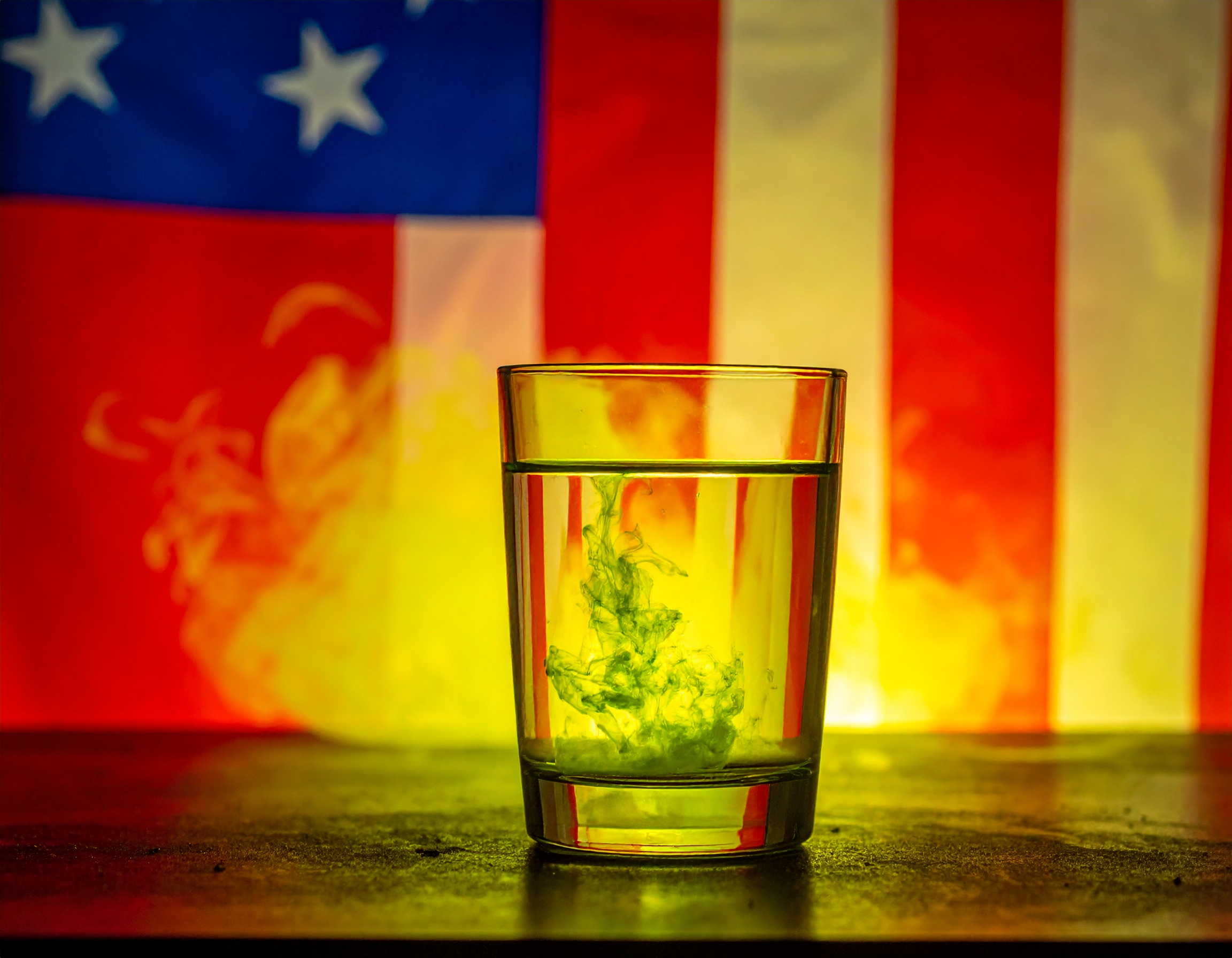
There are several man-made environmental factors that figure into Parkinson’s disease, with air pollution and industrial chemicals seemingly climbing their way to the top as the potential leaders. Some of the most infamous names in industrial chemicals known to medical researchers are the pesticides Paraquat and Rotenone, and the industrial solvent Trichloroethylene, or TCE.
Today, 17 million Americans are known to be exposed to TCE across nearly 400 drinking water systems in 41 states, with California, New York, Pennsylvania, Alabama, and Wisconsin among the states most that are most affected by the contamination. This once widely used chemical, used in military and industrial applications, was eventually revealed to be a cancer-causing agent for millions of Americans and has likely contributed to the spread of Parkinson’s disease.
What is Trichloroethylene, or TCE
Discovered first by French chemist Auguste Laurent in 1836 and later formally synthesized by German chemist Emil Fischer in 1864, TCE is a clear, colorless, non-flammable liquid with a sweet chloroform-like pleasant mild smell and burning sweet taste. The first industrial plant producing TCE opened in 1908 in what is now Bosnia, and commercial production reached the United States by 1925. It was widely used as a metal degreasing solvent, and over the next twenty years, its applications expanded to include aerospace and military uses, automotive manufacturing, decaffeinating coffee, and dry cleaning, until it was replaced by Perchloroethylene in the 1950s and 60s as the primary dry-cleaning solvent worldwide. TCE was sold under several brand names, including: Tri-Clene, Trielene, Trilene, Trichloran, Trichloren, Algylen, Trimar, Triline, Tri, Trethylene, Westrosol, Chlorylen, Gemalgene, and Germalgene
TCE use expanded greatly during World War II in cleaning aircraft parts, weapon components, and other military equipment by quickly removing oil, grease, and metal residue from precision machinery. Because of the chemical’s wide range of uses, the military and its contractors quickly adopted it for large-scale use, establishing it as the de facto standard industrial degreasing solvent for decades to come. Production of TCE expanded rapidly, soaring from 15 million pounds in 1942 to 75 million pounds by the end of the war.
During the 1950’s and 60’s, TCE hit its peak industrial use as the most commonly used solvent in the world in electronics manufacturing, automotive plants, aerospace facilities, and hundreds of consumer products.
From the 1940’s to the 1980’s, TCE extended to medical use as an anesthetic in hospital rooms under the name Trilene. However, when the chemical came in contact with anesthesia equipment, the chemical broke down into a neurotoxin that caused cases of nerve damage and facial lesions to develop, and in some cases, death. The FDA banned it as a surgical anesthetic in 1977.
Health risks of TCE surfaced almost immediately after the product became available for use, starting in the 1920’s with narcotic-type effects, as people were experiencing symptoms such as dizziness, sleepiness, and fainting. The following two decades saw toxicity studies increase as reports of TCE’s effects multiplied, focusing on acute exposure, documenting symptoms like headaches, impaired coordination, and nervous system depression. Some of the first reports of environmental contamination began to surface in 1949 when British chemists identified TCE in groundwater wells from industrial dumping.
By the 1960s, it was becoming apparent that workplace incidents were connected to rising health complaints among those who used TCE daily, prompting some industries to begin reducing exposure to the chemical. The establishment of the EPA in 1970 and the Clean Water Act of 1972 accelerated formal study of TCE’s dangers. Occupational studies done in the 1970s and 1980s found that factory workers who regularly handled the solvent and inhaled its vapors experienced higher rates of neurological symptoms, including dizziness, tremors, memory problems, and nerve damage. Additional evidence through laboratory testing identified damage to organs, including the liver and kidneys. Then in 1975, the National Cancer Institute issued a stern warning: preliminary laboratory findings indicated that TCE was a potent liver carcinogen, sending warnings across industries and government agencies that would eventually lead to the first regulatory restrictions.
EPA Superfund Sites
EPA Superfund sites are locations in the United States that are deemed hazardous because of contaminants, pollutants, and hazardous waste that pose an imminent risk to human health or the environment, requiring long-term cleanup of an affected area. One of the most well-known environmental disasters to take place was in 1977 at a New York neighborhood known as Love Canal, in Niagara Falls.
Several locations around the U.S. started to show extensive groundwater contamination around military bases and chip fab plants in Silicon Valley.
Groundwater testing of sites in Silicon Valley revealed extensive TCE contamination from semiconductor manufacturing plants, where companies had routinely used TCE and other chlorinated solvents to clean electronic components. One of the worst cases took place in December 1981 in San Jose, California, at Fairchild Semiconductor. Construction workers discovered a leaking underground chemical storage tank at Fairchild’s southern San Jose facility, and TCE had found its way into nearby drinking-water wells, showing contamination at nearly 20 times the EPA’s permissible limit. A month later, the San Jose Mercury News published the story. Over the course of two years, more than 60,000 gallons of toxic solvents had leaked from the tank, spreading underground more than half a mile into the surrounding neighborhood of Los Paseos. A subsequent study by the California Department of Health Services found 2.5 to 3 times the rate of miscarriages and birth defects among pregnant women who had been drinking the contaminated tap water. Santa Clara County authorities determined that 65 of the 79 companies that were investigated had contaminated the soil beneath their facilities, leading the EPA to designate 29 Superfund cleanup sites in the county, more than any other county in the United States.
Given that the time of TCE exposure and the onset of Parkinson’s disease can be nearly 40 years apart, those in Silicon Valley who could have been exposed to the effects of TCE would be experiencing the symptoms of Parkinson’s currently. Are there any active studies going on to look for this?
To date, there is no known study linking TCE contamination to an increase in Parkinson’s disease patients. Even though Santa Clara County hosts more federal Superfund sites than any other county in the United States, there has been no formal study to track Parkinson’s disease rates among the residents of Silicon Valley’s TCE-contaminated neighborhoods, including the communities surrounding Mountain View, CA, where 10 of those Superfund sites reside. According to the National Institutes of Health, there is strong evidence that TCE is strongly linked to a 70% increased risk of developing Parkinson’s disease.
Marine Corps Base Camp Lejeune
TCE groundwater contamination at military bases was a direct consequence of the military’s heavy reliance on TCE since World War II. Between 1953 and 1987, solvents like Trichloroethylene, Perchloroethylene, Benzene, and Vinyl chloride were stored at Camp Lejeune. The contamination of the drinking water was identified as coming from two consecutive sources: the Hadnot Point water system, which served barracks, the base hospital, schools, and family housing. The second source was the Tarawa Terrace water system, which served residents of the non-commissioned officers’ family housing. This area was contaminated primarily by Perchloroethylene (PCE) from a small family-owned business just outside the base gates called ABC One-Hour Cleaners. With laboratory tests detecting the contamination as far back as 1980, the military ignored the warnings given to them and deflected the blame to ABC Cleaners, deverting the attention from the more severe on-base contamination at Hadnot Point, a cover-up by the military and government officials that took decades to expose.
A 2023 study published in JAMA Neurology examined 172,128 military personnel who were stationed at Camp Lejeune and and 168,361who served at Camp Pendleton for at least three months between 1975 and 1985. At Camp Lejeune, water supplies were contaminated with TCE, PCE, benzene, and vinyl chloride. TCE levels were found to be measured more than 70 times the federally allowed limit. While the soldiers at Camp Pendleton, serving as the control group with no documented water contamination, found that 279 Camp Lejeune veterans had developed Parkinson’s disease by 2021, compared to 151 veterans from Camp Pendleton.
It is believed that 750,000 to 1 million people were exposed to contaminated drinking water at Marine Corps Base Camp Lejeune. From 1953 to 1987, Marines, civilian employees, and families were exposed to Trichloroethylene (TCE), Perchloroethylene (PCE), Benzene, and Vinyl Chloride while using the contaminated water for drinking, cooking, and bathing. Making the number of potential cases of Parkinson’s disease much higher.
The Relationship between TCE and Parkinson’s Disease
There have been multiple studies published that link TCE and Parkinson’s together, including the Camp Lejeune study. These include the Barrow Neurological Institute, Journal of Parkinson’s Disease, The LRRK2 Gene Study from the University of Pittsburgh, and Comprehensive Mechanistic Review (Molecular Neurobiology, Shandong University).
Some of the key results these studies all seem to share are:
- •TCE disrupts energy-producing mitochondria inside brain cells, the same damage pattern seen in Parkinson’s patients.
- •TCE triggers the buildup of α-synuclein aggregation, the toxic protein that is the hallmark of Parkinson’s disease.
- •TCE selectively destroys the dopamine-producing neurons whose loss causes Parkinson’s symptoms.
- •TCE (LRRK2 gene activation) activates a genetic pathway already known to predispose people to Parkinson’s, compounding the genetic and environmental risks.
Many researchers and clinicians believe that there may be two models of Parkinson’s: a brain-first and a gut-first model. Exposure to TCE and other pesticides and solvents known to influence the development of Parkinson’s may help to explain both pathways, making these chemicals uniquely harmful. While there are no available studies yet available that have conducted studies that directly isolate TCE’s role in each model, the existing science points toward a possible method of influence for both.
In the brain-first model, TCE vapor, inhaled from contaminated soil rising into homes and workplaces, triggers toxic changes in alpha-synuclein in the olfactory system, which then spread deeper into the brain. In the gut-first model, TCE consumed through contaminated drinking water passes through the digestive system, where alpha-synuclein pathology forms and then travels to the brain via the vagus nerve.
The End of TCE?
Well, no and yes. The EPA issued a final ruling regulating TCE on December 17th, 2024, prohibiting all uses of TCE within a one-year timeline, including manufacturing and processing, and most commercial and all consumer products. However, a motion was filed by several companies, led by battery manufacturer Microporous, LLC and PPG Industries, to block the ruling because they state there isn’t enough time to meet worker safety standards within the one-year time period. The EPA has postponed the ruling’s date several times, with the new date pushed to May 18, 2026. The Trump administration has indicated that it intends to weaken the rule through a new rule-making process expected to take up to two years
The core of the ban remains, however, industrial exemptions covering specialized military, manufacturing, and laboratory uses are at a standstill until the ruling is finalized in some way.
It is difficult to say whether the ban, weakened or not, can undo a century of contamination left in the soil or groundwater. Millions have already been exposed to what was once a revolutionary cleaner that has damaged the bodies of millions of American lives. Funding neighborhood studies for TCE exposure and identifying cancer and Parkinson’s cases should not require an act of political will, and the clock that TCE set in motion decades ago is still running.

Image by Chris Denny/NotebookLM
Discover more from
Subscribe to get the latest posts sent to your email.