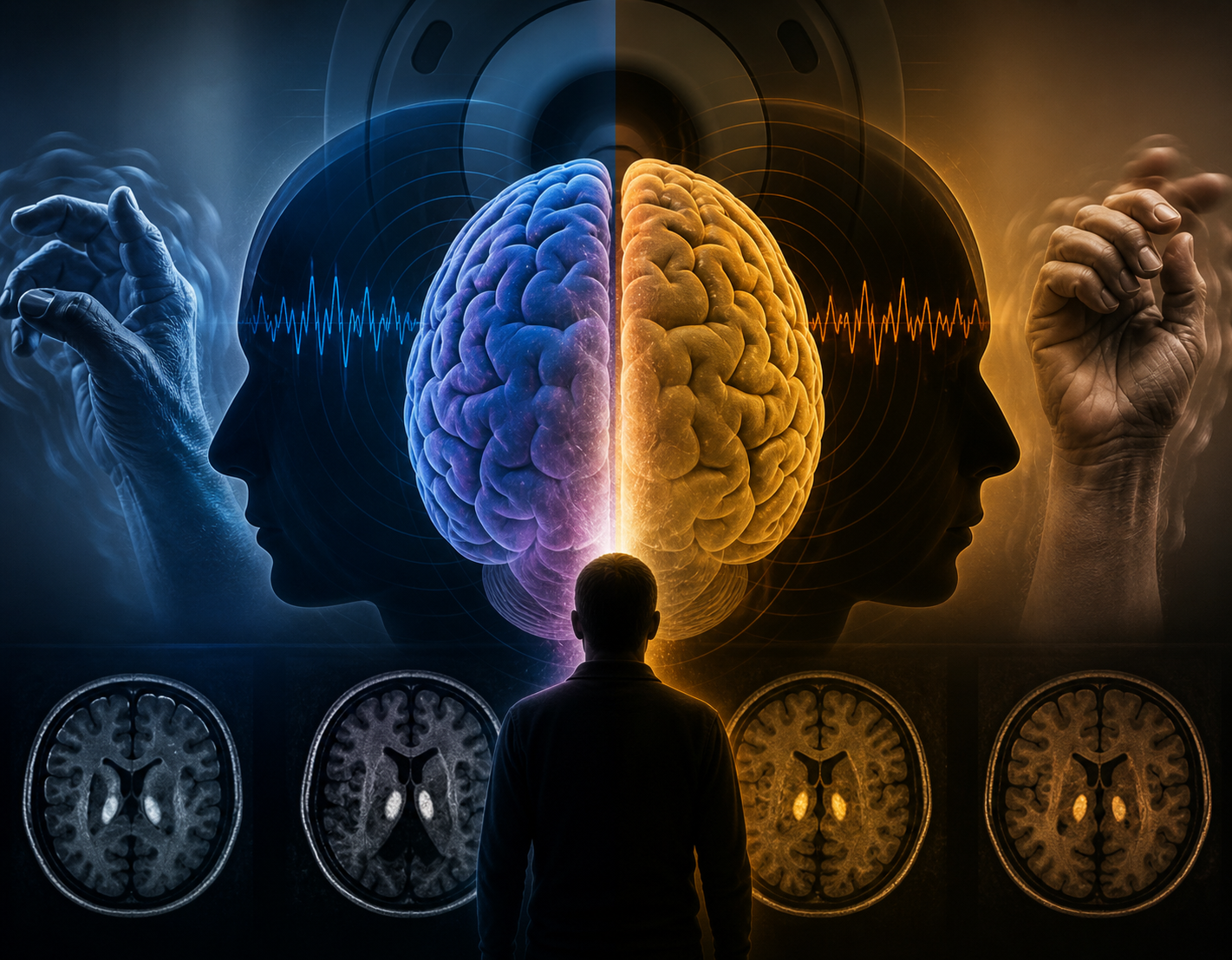
One day as you go about your routine, you casually lift your arm and your hand starts to shake. You set your hand back down and the tremor continues. There are many things that can cause tremors, too much caffeine, feelings of anxiety, side effects of medications that we take, and low blood sugar tremors that come with diabetes can make anyone’s body shake for a short time. Not all tremors though are short term and are more than a nervous twitch or an anxious moment.
The most common cause for tremors in people is Essential Tremor (ET), a condition believed to be caused by multiple genes that bout 50% to 70% of people with essential tremor report a family history of the condition. The results cause a misfiring loop between the cerebellum, thalamus and motor cortex producing an out of sync, repetitive and noisy communications between the three. For Parkinson’s Disease (PD) patients, the shaking that comes with the disease is a result of dopamine loss in the substania nigra which helps create conditions between the Basal ganglia, Cerebellum, and Thalamus that produce an oscillation effect between the three parts of the brain producing tremors in the hands, throat or other parts of the body.
Both Essential Tremor and Parkinson’s produce several types of tremors. Parkinson’s is best known for the “resting tremor.” This is where someone places their arm down on a surface and their limb will roll from one side to the other. Other types include the postural tremor which starts after holding a stance and the kinetic tremor, which happens during movement. Those with Essential Tremor will see kinetic tremors happen during movement, writing, walking, eating and speech. Postural tremors while holding out their arms or taking other stances. Those with ET also have Intention tremor. This tremor occurs when you are reaching towards an item and the hand starts to shake the more they get closer to the object. People with Multiple Sclerosis also experience this type of tremor.
For physicians, the difficulty can lie the in diagnosis of what disease someone may have by the type of tremors they are experiencing. The challenge isn’t just seeing the tremor, it’s interpreting it. Different disorders can produce similar types of shaking, and without a single definitive test, diagnosis often depends on careful clinical judgment. For patients, an incorrect or delayed diagnosis can mean years on the wrong treatment, a problem researchers are now working to solve. So, a new study published in Nature suggests that using MRI can offer solutions to determine what type of tremor someone has and an option for physicians to utilize while also revealing a gray area where the two conditions may overlap.
In the study of 335 individuals that participated, researchers used neuromelanin-sensitive MRI, which can pick up changes in dopamine-producing brain cells, along with the T1w/T2w ratio, a way of comparing two MRI images to get a clearer picture of overall brain tissue health, to analyze differences across groups of Parkinson’s patients, essential tremor patients, and healthy controls. Of those participants, 117 were tremor-dominant Parkinson’s patients, 43 had essential tremor (ET) with a resting tremor, and 94 had ET without a resting tremor, along with 81 healthy control individuals. The trial highlighted several interesting results that help point out key differences between the groups. In Parkinson’s patients, areas like the substantia nigra and locus coeruleus showed up dimmer on MRI images, suggesting the brain tissue in those regions was not as healthy or as pronounced compared to healthy controls. Patients with essential tremor showed stronger and more defined results, while the group with ET and a resting tremor appeared to fall somewhere in between the two.
These findings suggest that imaging can help distinguish between Parkinson’s disease and Essential Tremor, while also identifying patients where there may be some level of overlap between the two. That overlap points to the possibility of shared biology between Parkinson’s and ET, which is supported by multiple published studies showing that people with Essential Tremor have a significantly higher risk of developing Parkinson’s disease over time, with some estimates showing a two-to four-fold increase. Researchers have also observed clinical, genetic, and pathological overlap between the two conditions, suggesting that in some patients, essential tremor may represent part of a broader disease spectrum rather than a completely separate disorder.
What the research doesn’t fully cover is just how usable this may be as a diagnostic tool in practical terms. People’s biology can differ, which may influence how clearly these patterns show up from one patient to the next, meaning real-world results may not always be as consistent as those seen in studies like this. Additional studies and research, however, may eventually turn this into a diagnostic tool neurologists could use in the future to help diagnose patients.