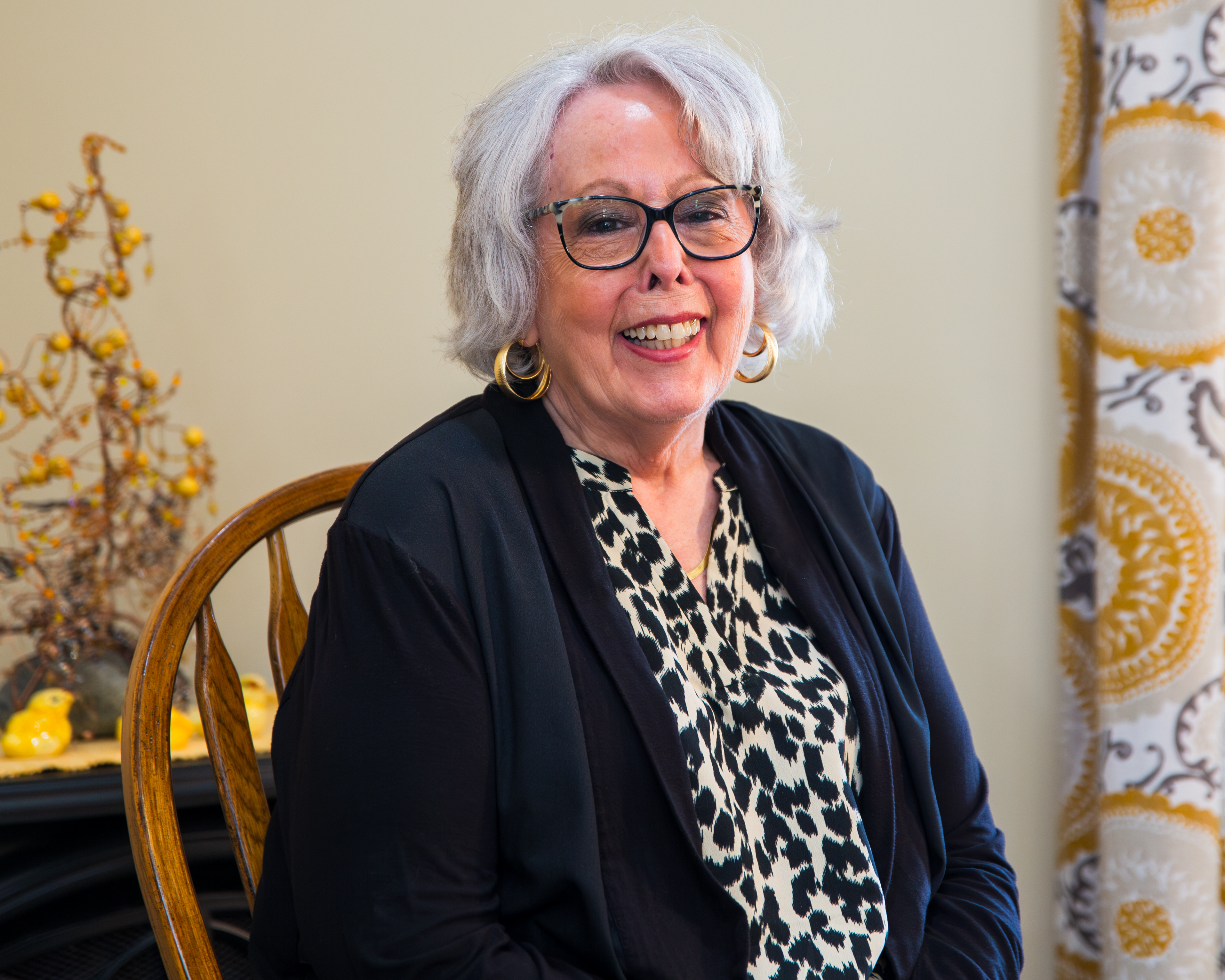
Parkinson’s Spotlight is a semi-annual feature highlighting individuals living with Parkinson’s Disease (PD). They share their experiences, discussing the daily challenges of adapting to life with PD and its effect on their families.
Today’s guest is Inez Voyles, a seventy-eight-year-old former nurse and a long-term healthcare administrator living in Corydon, Indiana.
Inez: “I’ve been a nurse for 60 years. I got my license in 1967. In 1987, I became a licensed long-term care administrator.
I’ve worked mostly with geriatrics and long-term care administration. So I’ve been, you know, familiar with patients that have had Parkinson’s disease. But that’s always something that’s way over in the side of your head that you think is never going to happen to you. I watched as my patients went through several different levels of diagnosis with Parkinson’s. And so it’s always been, I loved my geriatric patients, and I always wondered, you know, how they felt when a doctor talked to them and told them that they had Parkinson’s. I see the shakings coming on.
Chris: Did you have any relatives, grandparents with Parkinson’s?
Inez: Nobody in my family had Parkinson’s. That was a big surprise that none of my parents or siblings had Parkinson’s disease.
Chris: What was your first encounter with somebody who had Parkinson’s?
Inez: It was really back in the early days of becoming a nurse because of the medication that, you know, we had to give medication to patients and I became aware of, you know, Parkinson’s and the symptoms and the medications that they had to take for it.
Chris: And besides Parkinson’s, have there been other movement disorders that you have experienced as a nurse?
Inez: Yes, Huntington’s disease, multiple sclerosis, off the top of my head, I can’t think of a whole lot more, but I guess even with aging people, a lot of times you will see movement disorders, you know, that come up.
Chris: I’m just I guess where I’m going with this is trying to imagine myself as you as a nurse visiting people or you know take trying to take care of someone who has got some kind of movement disorder and the fact that it’s such a debilitating condition and you know I’m sure there are just people upset because they want it to stop and and all you can do is give them some medicine and hope it works.
Inez: Yeah, and when you say debilitating, it’s everything in your life that you’ve got to rearrange to live your life. You want to keep your independence. That’s probably one of the biggest things that I’ve known with aging, with myself aging. I keep wanting to be independent, but it starts taking away little by little of what you’re able to do.
Chris: What kind of things have you noticed?

Grasping objects are now more of a challenge while getting ready to start your day. 
Watching Inez as her hands shake while reaching for her medicine. 
Carbidopa Levodopa 25/100 a medication commonly given to Parkinson’s patients. 
Daily chores like loading dishes become more difficult. 
A photo of Inez at her home as we talked about Parkinson’s changing her life. 
Inez starting off as a young nurse. 
One of many tasks that gets harder as Parkinson’s Progress. 
Times of depression, a symptom of Parkinson’s. 
One of many memories traveling Router 66 befdore Parkinson’s Disease. 
Facility Administrator License from the State of Indiana
Photos by Chris Denny
Inez: I have a lot of shaking, and I’ve started noticing in the last year or so that I’ve started being more rigid. Like if I stand at the sink or something, my body has a tendency to want to curve away from what I’m doing, and it’s a rigidity that I had never experienced before. I have to be careful about walking. I really worry about falling and not being able to get up again. And then I like to be independent and involved with things in town, and because if I’m at a space in the day of where the fatigue hits me, I’m not able to be involved in very much, and that really bothers me too, because I’ve always been somebody that’s been very involved in the community and helping other people, and that’s kind of been taken away from me.
Chris: What kind of medicines do you take?
Inez: The Carbidopa Levodopa 25/100. I have two pills three times a day that I have to take. To start out the day you know you’ll be really, really shaky till you can get the medication down and right now that’s all I’m having to take and I’m thankful because it can make you very nauseated and it can make you very sleepy to where you don’t want to be out doing things.
Chris: Do you try to go out to some of the support groups?
Inez: You know, I haven’t. I’ve just been diagnosed for five years now. So I’ve been to one big support group after I was with Norton’s. But I haven’t been involved with a whole lot of groups yet. I’ve thought about doing that, but right now, I’m still trying to tell myself that I can keep going. And that’s I think that’s the main thing is could continue to have a good attitude and keep going. That’s why I’m so very interested in being involved with other people. and there’s some days. The bad thing that’s happened to me this past year was the depression that hit me. I was not aware of it; I mean, it blindsided me, and it knocked me down. It knocked me really bad. I had been exercising faithfully, and when that depression hit, it knocked me out of my routine., I’ve got to climb back into it.
Chris: Yeah, there’s a lot of non-motor symptoms with Parkinson’s. Depression is certainly one of the big ones.
Inez: That was a deep depression that I had. I mean, I’ve had some depression throughout my lifetime, but this was a bad one. I didn’t realize how bad, you know, I’d always dealt with it before and was able to keep going, but this time, it kind of knocked me.
Chris: I’m sure you saw that with people you were taking care of.
Inez: Yeah, yeah, yeah, over the years. Well, and not just diagnosis of Parkinson’s, other kinds of symptoms and things that people have had to deal with, you know, and learned how to crawl out of it. But being good to yourself is what you need to do, and I guess the good thing about having Parkinson’s and depression at this point in my life is that I’m learning to say it’s okay if you want to relax for the day, if you want to do something off the wall, because, you know, you don’t have that responsibility of getting up and going to a job every day. So, I concentrate on my family and myself.
Chris: What advice would you give to someone who’s just starting their journey with Parkinson’s when you first meet them?
Inez: Don’t give up. You never give up. I don’t care what situation you’re in. I mean, at some point, you may have to, but in your mind, you’ve got to figure out how you’re going to deal with it and get over the hurdle. There’s going to be a lot of hurdles in your way, but you’ve just got to keep going. You can’t stop. The experience with the doctor who told me that I had Parkinson’s was the first doctor I dealt with. I went to see him. He did the diagnosis. He looked at me, talked to me about my symptoms, and he just leaned over and said, “You have Parkinson’s.” He never, ever said anything else to me. I just got up and left his office. So, to me, I think that caregivers have some way to explain to you, this is what you’re going to be facing. I wasn’t told that. To me, that was the biggest blow because I always thought I was such a good caregiver to all of my patients and all my employees who worked for me. I thought I was such a good caretaker, and this doctor handed me that diagnosis and let me leave his office without an explanation. Where do you go next? Are you going to have to take medication? What do you do now? They never say it. Immediately, I never went back to that doctor again. I then went to a doctor at Norton’s, and I’m on my third doctor at this point at UofL, and I really feel pretty confident with her. She talks to me about things that we need to talk about.
Inez worked at Wedgwood Healthcare Center in Clarksville, Indiana, for eight years and at Kindred Nursing and Rehabilitation Center in Corydon, Indiana, for 14 years. She also spent a year working in northern Indiana and has 30 years of experience as a building administrator. After retiring, she contracted with Kindred, providing temporary support as an administrator and provided support for facilities that were closing.
Inez strives to maintain a regular schedule, waking up at 7 a.m., getting dressed, and making her bed despite the tremors caused by Parkinson’s disease. She takes her medications and attempts to have a normal day based on her energy levels. She enjoys watching YouTube videos about Parkinson’s and motorcycle travel, which is a shared interest with her husband, John. Inez leads a fulfilling and productive life while living with Parkinson’s and is reaching out to connect with others in local support groups.
To find local Parkinson’s support groups in your area, click here.