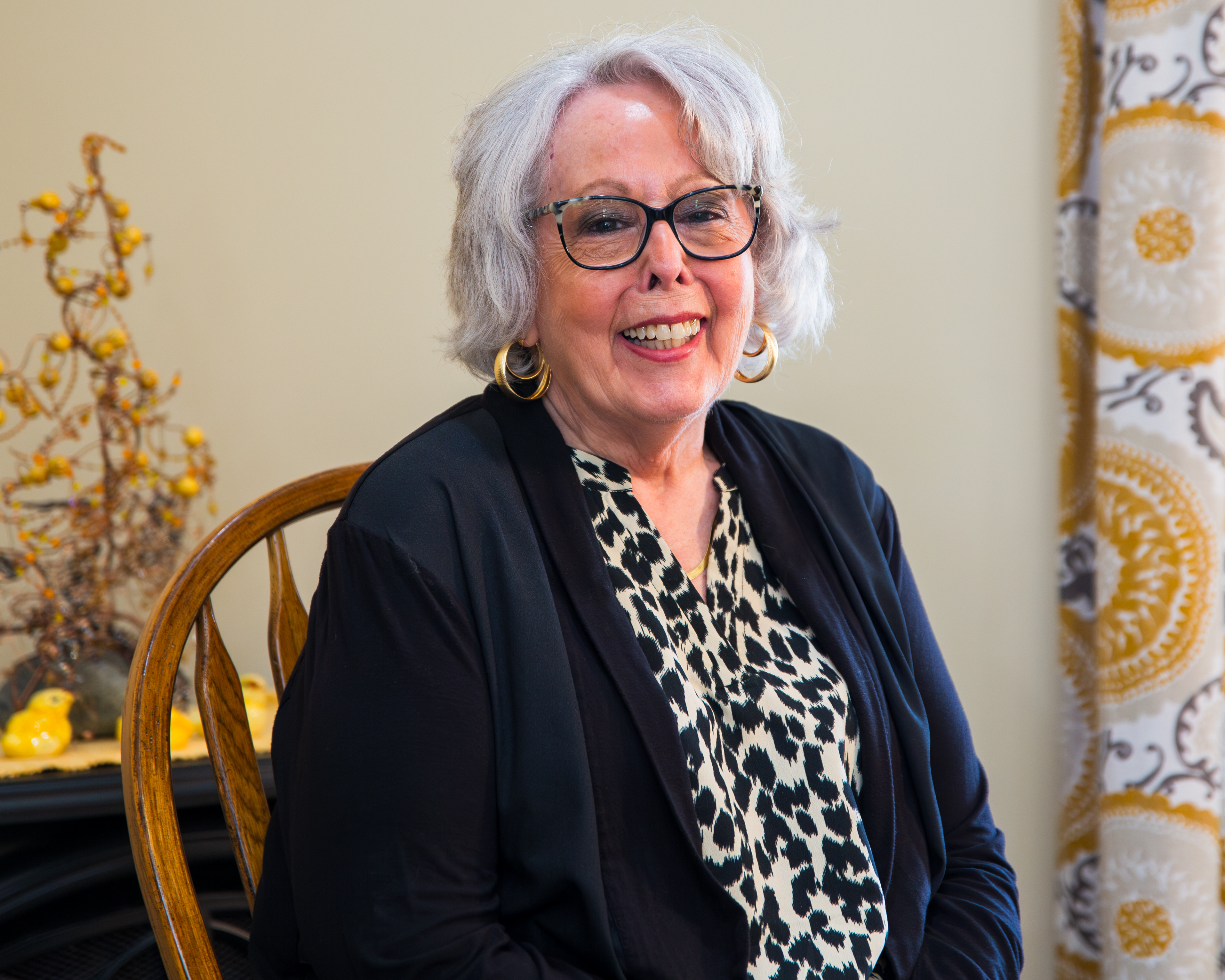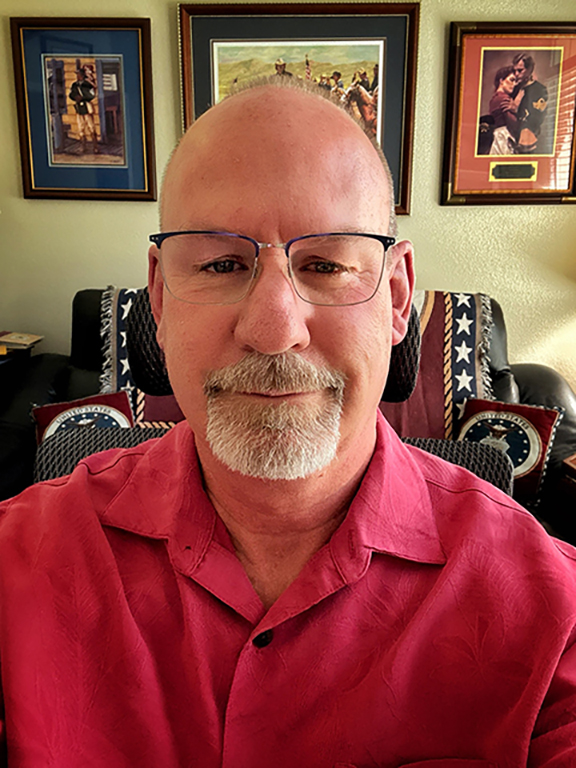
Parkinson’s Spotlight is a semi-annual feature highlighting individuals living with Parkinson’s Disease (PD). They share their experiences, discussing the daily challenges of adapting to life with PD and its effect on their families. The guest for this edition of Spotlight is Chris Anthony.
Chris was diagnosed with late-onset Parkinson’s Disease in January 2025 and shares his journey with the disease on his newsletter, From Where I Sit, published on Substack. He is a retired U.S. Air Force Senior Master Sergeant, former senior leader with the Department of Homeland Security, and consultant. He now devotes his time to writing, woodworking, and Parkinson’s advocacy. Chris’s newsletter describes the challenges that come with Parkinson’s disease and how he is reminded that living with Parkinson’s is a full-time job and never lets go. His persistence and determination serve as a powerful example of resilience and the importance of never giving up.
From Where I Sit: My Parkinson’s Journey and a Word for the Newly Diagnosed
First, I want to thank Chris for featuring me and my Parkinson’s journey on Our World in Words and Film. I am a newly diagnosed Parkinson’s warrior—diagnosed on January 17, 2025. I’m 62, so technically I have late-onset Parkinson’s disease (LOPD), which means symptoms like tremors, rigidity, and slowness of movement appeared after the age of 50.
Like many who hear the words “you have Parkinson’s,” my first reaction was secrecy. I swore my wife Christine to silence. My only reference point was my dad, who was diagnosed in his 70s. When his symptoms first appeared, his doctor dismissed them with, “He’s just an old man. Old people shake.” By the time my father’s Parkinson’s worsened, I had watched Dad’s friends and church family slowly drift away. Two decades ago, Parkinson’s was seen almost exclusively as an “old person’s disease.” Deep down, I feared people would think of me in the same way.
A Change of Attitude
Everything shifted a few days after my diagnosis. Christine discovered that the Michael J. Fox Foundation was hosting its Parkinson’s IQ + You symposium in Orlando. She signed us up. I went reluctantly. I assumed I’d be walking into a room full of people with advanced Parkinson’s, a mirror of what I thought my own future would look like.
Instead, I was surprised. The event—held at the JW Marriott near Disney—was like other professional conferences I had attended: strong speakers, knowledgeable vendors, an overflowing bag of brochures and freebies. But the true takeaway wasn’t in the sessions or handouts. It came from simply sitting in a giant ballroom surrounded by hundreds, maybe over a thousand, fellow Parkinson’s warriors.
I expected to see mostly advanced symptoms. I was wrong. The majority of attendees showed little outward sign of disease. Many were newly diagnosed like me, still figuring things out. Others were seasoned veterans—living full, engaged lives, supported by care teams, exercise programs, support groups, and even fundraising campaigns for research. They weren’t hiding their diagnosis. They were sharing their stories openly, reshaping what it means to live with Parkinson’s.
That day, I realized: secrecy helps no one. If I were going to face Parkinson’s, I needed to be part of the conversation.
From Where I Sit: An Online Publication
I knew I wasn’t cut out for podcasting or becoming a social media influencer. But I could write. So I launched a Substack publication called From Where I Sit.
My goal wasn’t to be an expert voice on Parkinson’s. I was, and still am, too newly diagnosed for that. Instead, I wanted to make sense of my own journey and share it honestly. Over time, my essays have explored blame, adaptation, invisible struggles, and the challenge of building a care team.
Most recently, life forced me to write about something I didn’t expect: my heart. Like many with LOPD, I face health issues beyond Parkinson’s. After jumping back into exercise routines too aggressively, I began experiencing shortness of breath. A cardiologist discovered a 70% blockage, which led to angioplasty.
That episode taught me an important lesson: while exercise is one of the most effective tools for slowing Parkinson’s progression, it must be approached wisely. For those of us with LOPD, it’s crucial to undergo a thorough physical examination before engaging in high-intensity programs. Managing Parkinson’s is already a long game. We can’t afford to be sidelined by preventable complications.
A Word for the Newly Diagnosed
If I could leave one message for someone just receiving their Parkinson’s diagnosis, it would be this: take a deep breath. You don’t have to solve everything today.
Here are a few early lessons that have made a difference for me:
- Get a complete physical check-up. Make sure your heart, joints, and overall health are ready before beginning a rigorous exercise program. Exercise is medicine for Parkinson’s—but only if it’s safe. I didn’t do this. I should have.
- Embrace movement. Once cleared, commit to consistent activity. It doesn’t have to be extreme—what matters most is sustainability. Momentum is built through repetition, not perfection.
- Build your care team. Neurologists, therapists, and specialists each bring pieces of the puzzle. Find those who listen, explain, and earn your trust.
- Expect to adapt—constantly. Parkinson’s is not static. Adapting again and again is tiring, but it’s also proof of resilience.
- Talk about the invisible struggles. Fatigue, pain, posture changes—they count, even if others can’t see them. Share them with your care team and your circle.
- Release the urge to blame. Whether it’s genetics, toxins, or bad luck, focusing on the cause won’t move you forward.
- Give yourself grace. Some days will be harder than others. Celebrate small victories and forgive setbacks.
- A Recommended Resource. I recommend reading The Parkinson’s Plan by Ray Dorsey, MD, MBA, and Michael S. Okun, MD. The authors are both on the cutting edge of Parkinson’s research. In their book, they outline practical steps to prevent, slow, and treat the disease. They demonstrate how the food we eat, the water we drink, the air we breathe, and the lifestyles we lead all contribute to shaping outcomes.
I don’t write because I have all the answers. I write because Parkinson’s is not a solitary disease, even if it sometimes feels like one. By sharing my story, I hope others see glimpses of their own—and perhaps find the courage to keep adapting, keep moving, and keep living fully. One day, one adjustment, one victory at a time.

Portrait courtesy of Chris Anthony