Parkinson’s disease, other movement disorders, and elderly care can require an immense amount of time and effort, depending on the severity and the situation the patient and caregiver face. We all strive to be independent and self-reliant, preferring not to have to rely on others to do everyday tasks like cleaning, cooking, personal grooming, bathing, or even getting dressed. As age and disease catch up with us, the body starts to change in ways that start to slow and diminish our movements and interrupt our thought processes. Memory can begin to slip, and those things we hold dear start to slip slowly away.
For millions of people around the world, those who experience diseases like Parkinson’s have someone who cares enough to stand by them in a supportive role. For some, it’s a spouse, for others, it’s a family member or friend, and for others, care is provided by a hospital or other medical services.
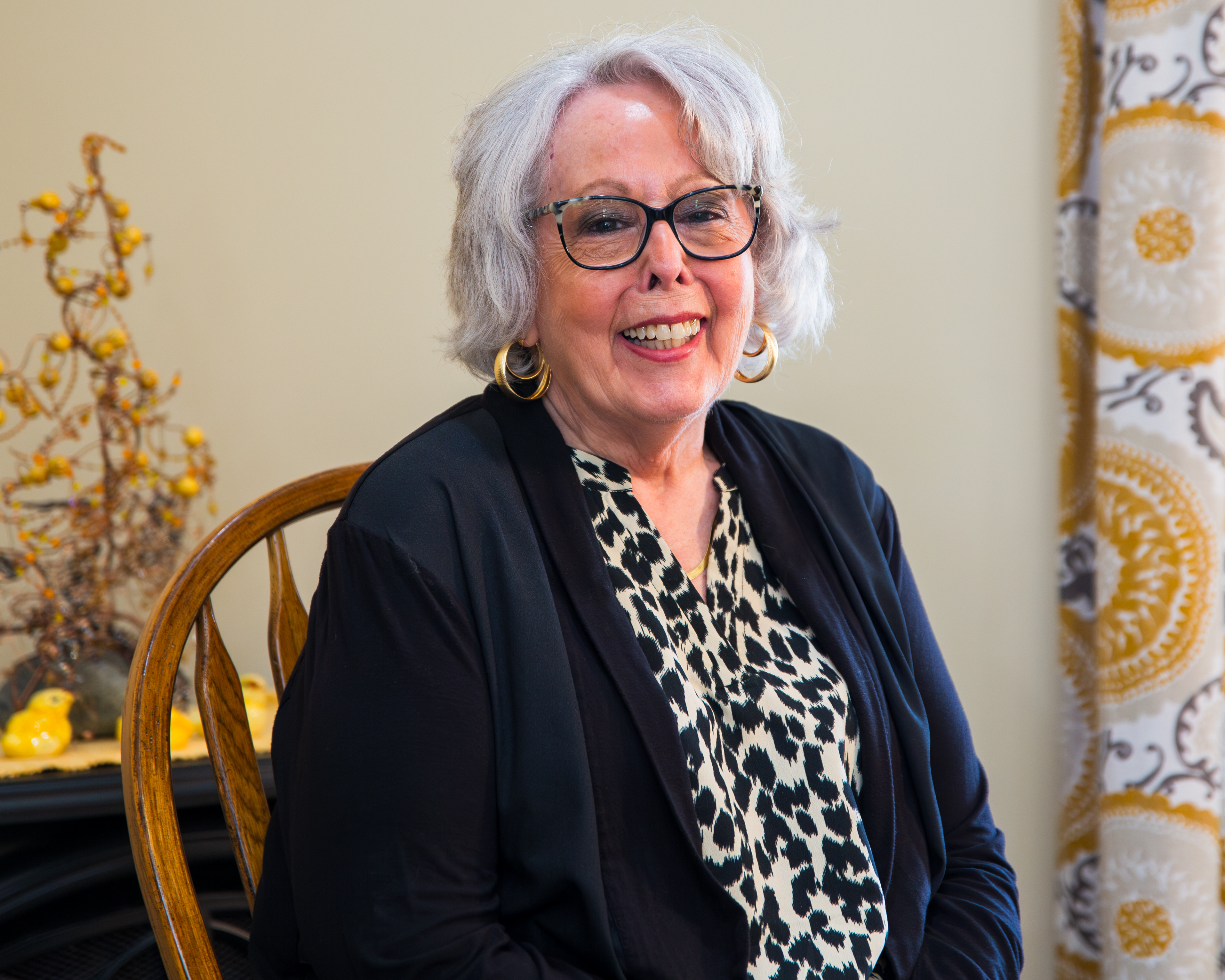
This Parkinson’s Spotlight is about a caregiver named Paula Payne and her mother, Patricia Payne. Paula is a retired Registered Nurse who spent 33 years in the medical field and has a 16 year old basset hound named Frisco. Her last job was working at a regional hospital in Jeffersonville, Indiana, for children, adolescents, and adults, providing inpatient and outpatient care.
Paula lived with her mother, Patricia, who was diagnosed with Parkinson’s disease at the age of 40. Paula said her mother was initially in denial when she first learned of the diagnosis. “Well, at first, she was in major denial,” Paula said. “She went to her family doctor because she had recently pulled out our Christmas tree, and it was heavy; she thought she had a shoulder injury. Her shoulder hurt, and she noticed a tremor in one of her fingers. So she went to her family doctor, and he had her walk and told her that he thought she had Parkinson’s. Well, after that, she saw five different neurologists, and they all told her the same thing.”
Learning that you have a disease like Parkinson’s can take an emotional toll for some. There’s a lot of uncertainty someone will face, wondering what changes in their life will happen and how they will have to adjust to the changes in their job and at home. What do they have to do, and what will this mean for them and their family?
When asked about her mom’s reaction to the diagnosis and how she handled the news, Paula said, “Um, she did a lot of research about Parkinson’s that pretty much consumed her for a while; she finally accepted the fact that she indeed had it. We were pretty lucky in that the progression of her disease symptoms was pretty slow. So she was functional for quite a while after she had it. Or after she was diagnosed, rather.”
One of the non-motor symptoms that all Parkinson’s patients have to live with is depression. According to several studies, 30-40% of patients with Parkinson’s live with depression at any given time, often accompanied by Anxiety that affects 40% of Parkinson’s patients. The Parkinson’s Foundation indicates that depression has the greatest impact on quality of life for those with the disease.
For Patricia, those symptoms stayed with her as her Parkinson’s symptoms continued to grow. Paula said, “She had a lot of depression. Well, I can’t say in the beginning, she had a lot of depression because she remained active. But in the end, a lot of depression over being immobile. At night, she would have a lot of anxiety, but they put her on an antidepressant fairly early because one of the neurologists, I can’t remember her doctor’s name, said that goes along with it.” When asked if she spoke to Paula about it, “ Uh, she didn’t talk a lot about the depression. Um, I guess she was that the way she was brought up; mom wasn’t a big believer in mental health and treatment for it. She was kind of a more, uh, pull yourself up by your bootstraps type person. So she didn’t really discuss the mental health aspect of it with me. She may have been with other people.”
Parkinson’s is not a singular disease; according to the Parkinson’s Foundation, 90,000 people are diagnosed with it each year. Groups sponsored by local hospitals and non-profit organizations are stretched across the country and overseas to help lend a hand and to let others know they aren’t alone. When I asked her if she had reached out to find others, Paula said, “She did a lot, she was invested pretty heavily in the Michael J. Fox Foundation. And I’m not sure how, but she discovered some other people who had it at a young age, and they would stay in contact.”
It was with the help of those connections with the Parkinson’s community that opened the door to a chance at the opportunity to advocate directly for research and awareness.
Paula and Patrica journeyed to Washington, D.C. in 2004 through a grant from the Michael J. Fox Foundation to talk to government representatives about supporting and funding Parkinson’s research. “We met with our Congressional representatives to advocate for more funding for Parkinson’s research. I remember talking with Baron Hill specifically.” Remembers Paula. “There were others, but he’s the one who stands out. After our time at the Capitol, we had time to explore the city. We went to the Washington Monument, the Lincoln Memorial, the Vietnam Wall, a memorial for nurses who served (Vietnam Women’s Memorial), the front of the White House, and the National Mall. We were also able to meet and speak with many others with Parkinson’s from all over the country.” When asked about speaking to members of Congress, Paula remarked, “They seemed very willing to listen and very receptive of our message. I loved getting to tour the city and the historical landmarks. It was a very educational trip. I enjoy history.”


For Parkinson’s patients, exercise is key to fighting off the effects that the loss of dopamine has on the body. With most patients, 60–70% of dopamine neurons are lost before Parkinson’s motor symptoms appear, but research increasingly suggests that regular aerobic exercise may help preserve dopamine signaling and slow symptom progression. Paula says her mother never went to exercise groups or other types of programs,” But she liked to garden a lot. Paula said, “ So that took up a lot of her time with the flowers and the garden.”
As a caregiver, responsibilities vary wildly, with some days being more intense than others. Driving to appointments, trips to the grocery store, and other errands certainly make for a busy day for yourself, but when you take on the responsibility of someone else, those duties can double. Paula talked about what Patrica could do on her own at first. “ At first, for a long time, she drove; she eventually gave that up on her own, because after being on the medicine and trying to get her adjusted, she had a lot of dyskinesia, which made driving unsafe. So I became her transportation. I cooked a lot, and I went to the doctors with her to make sure, you know, of what they said.” Paula said she was able to keep her job as a nurse for a while, but eventually had to give it up to provide full-time care for her mom. Paula said that things for her mother, Patricia, got worse for her starting at the age of 60. I asked her how her role as a caregiver shifted when her symptoms worsened.
“Well, and at first I was able to work outside. I hired people to come sit with her at night because the main problem was getting up to the commode.” But in 2018, I left my job and became a full-time caregiver to her because she needed round-the-clock care.
Paula described her day-in-a-life as “Well, when I went full-time as a caregiver, I had to be available around the clock at night. She would yell for me when she had to go to the bathroom, and our bedrooms are next to one another, so I could hear her, and then we would just get up, and I would make her breakfast and do the dishes. I compare it to having a small child. Although she wasn’t always childlike in her mentality, she became like that in the end.” She describes Patricia’s cognitive abilities as starting to take a turn for the worse. “Yeah, she became very confused at night. She would. She would accuse me of having people over to party and make food at night, and she would wake up very angry about that.”
Asking about Paula’s ability to cope, where she thought I couldn’t do this anymore, she stated, “Oh, many days. I thought that my mind. I never told that to my mom. Of course, I didn’t want her to feel bad about me being her caregiver. But in my mind, I would think that.” I put the question of “ever feel like giving up” to her, knowing the stresses she must have been going through would make anyone want to walk away after a while. “I did, but I knew I couldn’t. I felt like, you know, she had raised me, and it was my responsibility to take care of her now. Paula said. To cope with her stress, she said,” Well, to be honest with you, Chris, at first I drank, and that wasn’t a good move on my part. I guess just, you know, reading about it and researching and trying to maintain relationships with friends.” My best friend is a social worker, so she knows a lot about helping people and a lot of that stress. So I did therapy. I was able, with the help of a sense of care, It would free up a few hours a week to like go to the grocery, and I would use an hour of that time to do therapy, and my therapist was really good about talking to me about it.”
In many cases, Deep Brain Stimulation has positive effects on the recipient. Allowing symptoms of Parkinson’s to ease and let people live a more normal life, but according to Paula, DBS effects on her mother Patricia weren’t as optimal as they could have been. “It was scary to think that they were going into her brain, and afterwards, it wasn’t as positive as we had hoped. It took away her ability to walk, which the doctor said could happen. He had warned us ahead of time. It did allow her to cut back on her medication, but I think if she had had it to do over again, she probably wouldn’t have done it because, as I said, it took away her ability to walk.”
Near the end of Patricia’s life, Paula would have to face more problems, with the onset of dementia creeping in. “She got to the point where she was very confused. And, um, when I would leave the room, she would call 911, and I came in and caught her once, and I said, mom, what are you doing? And she said, well, I’m just tired of sitting here, but, uh, at first they were like understanding when I told them that she was confused, but then when she kept calling 911, they’re like, well, maybe we need to check this out.” She goes on to finish, “ Maybe it’s some older person being abused, but the last time she went with them, and when she got in the emergency room, she told them that I had punched her in the face.”
“Now, there was no bruising or marks or anything like that. But they did come in and talk to her about maybe doing a short-term stay at Indian Creek. When she got there, they suggested hospice, and she signed on with that. She stayed there for a couple of months, and I would visit her.”
“I got a call one day that there had been a change. So I rushed up there and, um, she had been found the day before, but the day they reported a status change, she was totally out of it and became unresponsive. I still question, you know, what exactly happened. But she went through that, which was the day she passed. It was a horrible process. She went through something called terminal agitation, which I’ve come to learn that 60% of Parkinson’s patients go through it, but it was the death process itself was a real struggle for her. It went on for eight hours. Even though she was being heavily and appropriately medicated, it didn’t seem to touch her.
For Paula, the death of her mother at 70 brought a long road to an end, though the emotional scars of that journey will remain long after the final chapter closed. When I asked what sense of relief there was for her, “ Um, it, it’s still a work in progress. It took me a long time to get those images of her passing out of my head. Um, it did help to read that 60% of Parkinson’s patients experience it. Um, but I’ve spoken to my therapist, and she reassured me that, uh, mom was probably unaware and, uh, several of my former coworkers have gone on to work hospice, and I’ve been able to speak to them about it. So that made me feel better. ”I’m still not back to normal. I’m still in a lot of therapy. But I do have to say things have gotten better with time, and I am glad for the fact that she’s no longer suffering. So I know that for sure.”
Paula’s advice to those who are caregiving or are new to being a Parkinson’s caregiver she says: “ I would say that if someone offers to help, or there’s any way that you can get any outside help, definitely take it. Um, and any moment that you have to get a little break in, definitely take that too.”