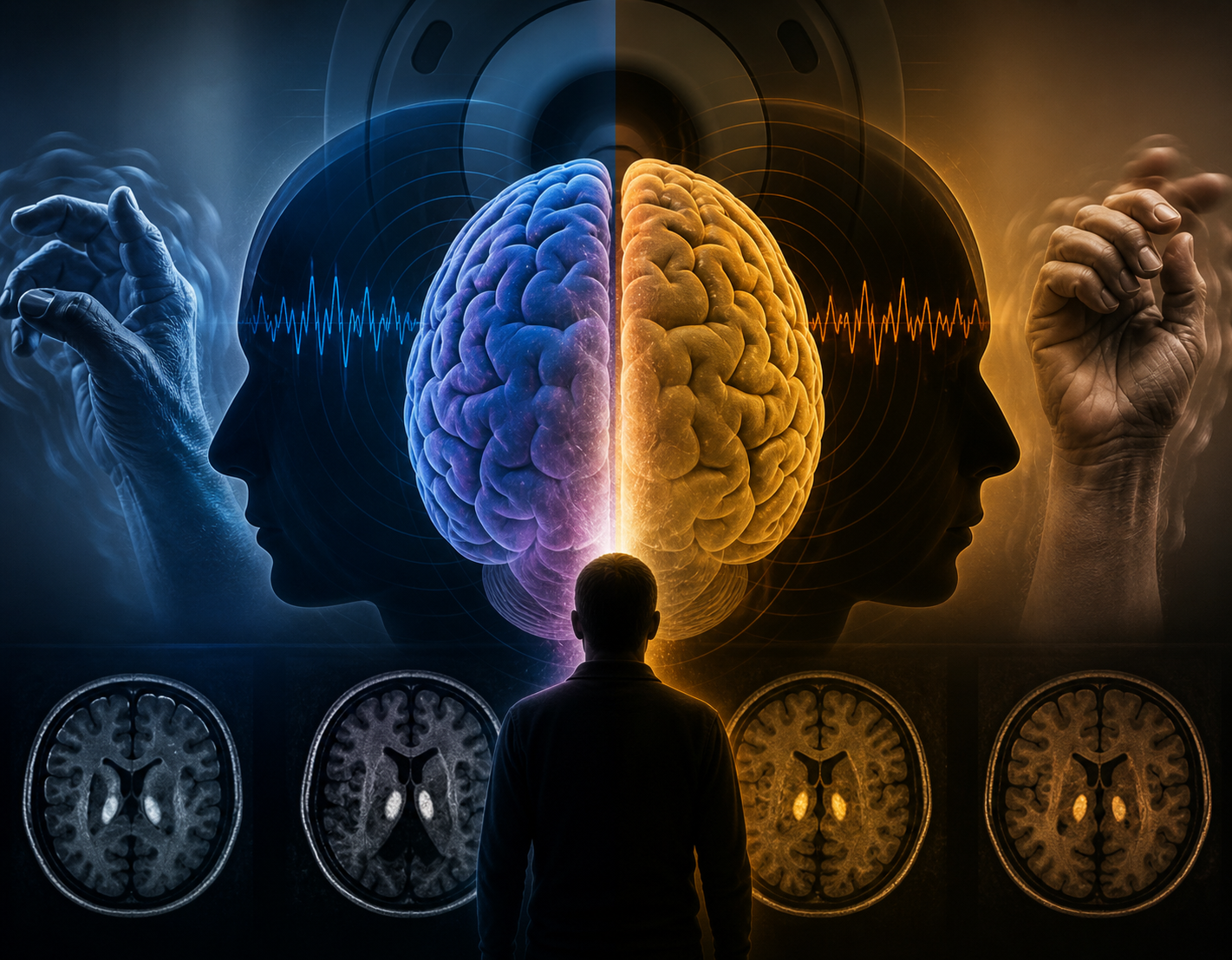
A double-blind study published in Nature Communications was conducted on a small group of people with Essential Tremor (ET) using a technique called Transcranial Static Magnetic Field Stimulation (tSMS) to determine whether tremors could be temporarily reduced.
What is tSMS
Transcranial Static Magnetic Field Stimulation targets the Primary Motor Cortex with a powerful neodymium magnet, held in place with a helmet-type device, targeting the part of the brain that controls hand movement. tSMS produces a static magnetic field that reduces brain activity beneath it. The static magnetic field dials down the brain cells’ tendency to activate. It suppresses activity in the motor cortex, making the development of tSMS into a future tool for those with ET possible.

About Essential Tremor
Essential Tremor (ET) is a neurological disorder characterized by rhythmic, involuntary shaking that affects the hands, arms, and other parts of the body, including the vocal cords. Researchers once thought ET was isolated to only one part of the brain, but now believe ET encompasses the entire interconnected network of the brain itself, consisting of the cerebellum, thalamus, motor cortex, supplementary motor areas, and the communication pathways between the left and right hemispheres. All regions of the brain contribute to movement regulation, but in ET, the entire network becomes overly synchronized and unstable, leading to rhythmic tremor. Studies using Electroencephalography (EEG) and functional Magnetic Resonance Imaging (fMRI) have shown that areas like the cerebellum, thalamus, and motor cortex send coordinated, balanced signals to one another, checking in with each other, but don’t fire at the same time. Patients with ET, however, begin firing in an overly connected, overly synchronized pattern. This activity is what scientists call “abnormal coupling,” and it causes the cerebellum, thalamus, and motor cortex to reinforce each other’s tremor signals. Instead of regulating these signals and allowing the system to reset normal movement control, the active network ends up strengthening the repetitive rhythm of the tremor.
Who Participated in the Study?
The double-blind study consisted of 27 patients with an average age of 66 years old living with ET for 26 years. 85% of the participants were taking tremor medications such as Propranolol and Primidone, which are recognized as first-line medications. All 27 participants had tremors in both hands; 22% also had a resting tremor, and just over half had what is called Axial Tremor, or tremors in the head and torso.
Those in the study received one 30-minute session with tSMS with no repeated therapy, measuring the immediate short-term impact of a single session only. Wearing accelerometers on their hands, tremor frequency, kinetic tremor, which is scored by drawing spirals, the frequency of their tremor, by measuring cycles per second, resting tremor, and postural tremor amplitude, which was done by holding out their hands, were all measured as part of the study.

Results
The results of the research revealed some very positive outcomes for those who participated in the study. In the study, the researchers found that applying tSMS to one side of the motor cortex reduced tremor not only in the hand on the opposite side of the body, which is normally controlled by that brain hemisphere, but also in the hand on the same side. Tremor in the contralateral hand (the opposite side of the body from the part of the brain being stimulated) dropped by 60.9%, while tremor in the ipsilateral hand (the hand on the same side of the body as the part of the brain being stimulated) still improved by 51.8%. This suggests that calming activity in one side of the brain influenced the entire tremor network, which is highly interconnected in Essential Tremor. As a result, even though the magnet targeted only one hemisphere, both hands benefited almost equally. The hand on the opposite side improved a lot, about 61% less tremor, while the hand on the same side also improved nearly as much, or about 52% less tremor.
Researchers stated: “Our study suggests that one session of 30-minute tSMS applied to the primary motor cortex of ET patients is safe and may reduce postural and rest tremor at least in the short term, with comparable effects observed in both the contralateral and ipsilateral hand relative to the stimulated hemisphere and no effect on tremor frequency. The effects appeared to subside within 15 min, indicating a return to baseline tremor levels. The effects on kinetic tremor were inconclusive.”
Researchers also conclude: “ Overall, the results of this study suggest that tSMS may improve tremor in ET. These findings indicate that tSMS is a promising therapeutic approach for the treatment of ET, which should be confirmed in randomized controlled trials with multiple sessions of tSMS.”
While drugs like Propanolol and Primidone offer positive drug therapies and surgical options with Deep Brain Stimulation and High-frequency Ultra Sound for patients who suffer from ET now. This pilot study provides hope for a future therapy that could one day turn into a wearable device or a surgical treatment. Knowing that there are ways to give those with Essential Tremor another possibility of relief offers hope to those who have to live with the disease now.
The study in its entirety can be read in Nature Communications
Unless noted, all media by Chris Denny