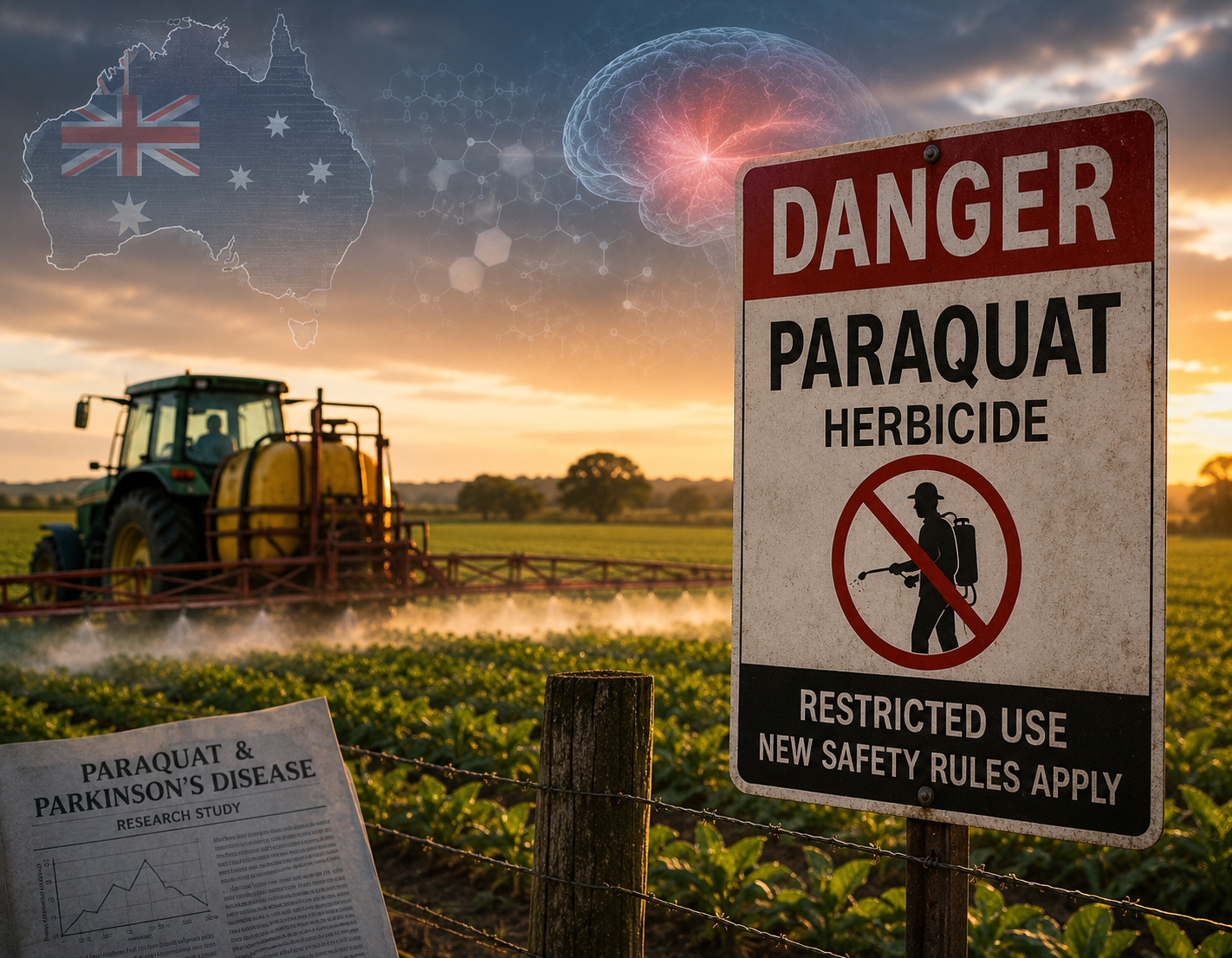
In a surprise move, Australia’s pesticide regulator, the Australian Pesticides and Veterinary Medicines Authority (APVMA), announced it will tighten restrictions on Paraquat, including lower application rates and new equipment requirements, but stopped short of banning the herbicide. The decision follows a nearly 30-year review by the APVMA, which concluded that the available evidence does not demonstrate that paraquat, when used according to approved directions, increases the risk of developing Parkinson’s disease, even though 70 countries across the globe have banned the chemical from use.
According to a statement made by APVMA’s Scott Hansen, “The weight of evidence does not show that paraquat exposure through approved uses increases the risk of developing Parkinson’s disease.” Even though the preponderance of evidence states otherwise.
The new restrictions imposed for the use of the herbicide include a reduction in the maximum application rate from 1,150 grams per hectare to 231 grams per hectare, the phase-out of backpack sprayers, and requirements for enclosed mixing and loading systems. Enhanced personal protective equipment for applicators, with a two-year transition period to phase out and relabel existing products.
The Grain Producers of Australia hailed the decision as a victory for science-based regulation, and GPA spokesperson Andrew Weidemann described it as a positive outcome for grain producers. Agricultural organizations broadly welcomed the decision to keep paraquat available, arguing the herbicide remains an important tool for weed control and conservation farming, helping reduce soil erosion and preserve moisture through no-till agriculture, while acknowledging they will need to adapt to the new restrictions. In a statement by Australia’s National Farmers’ Federation President Hamish McIntyre, “We acknowledge the community concern around paraquat, and it is absolutely critical that the products farmers use are safe for both people and the environment.”
Neurologists questioned the decision, saying people living and working around agricultural areas remain at risk from long-term exposure. Parkinson’s Australia criticized the decision, arguing that evidence linking paraquat and Parkinson’s warrants stronger action. Disappointed with the decision, Olivia Nassaris, Parkinson’s Australia CEO, stated, ‘The APVMA has failed not only farmers who use paraquat, but all the other Australians exposed to it,’ asking, ‘Are the lives of Australians less valuable than the lives of the people living in these 70 countries that have banned paraquat?” According to neurologist David Blacker, “Like myself, people who grew up on farms and live around places like golf courses that are using paraquat aren’t safe.”
Paraquat is one of the world’s oldest, most widely used, and most controversial herbicides. Introduced commercially in 1962 under the brand name Gramoxone, it quickly became a global agricultural staple, valued for its ability to kill weeds rapidly while becoming inactive on contact with soil, and for enabling conservation farming practices that reduce tilling, limit soil erosion, and retain moisture. Beginning in the 1980s, researchers started investigating whether long-term occupational exposure might increase the risk of Parkinson’s disease. The herbicide has been responsible for 8,000 cases in the U.S. court system because of the effects it has had on people diagnosed with Parkinson’s disease, with plaintiffs arguing that manufacturers knew of the risks and failed to warn users. Though not directly responsible, that legal pressure has been accompanied by legislative action by the state of Vermont, which became the first U.S. state to ban paraquat when Governor Phil Scott signed H.739 into law on May 26, 2026. The landmark legislation will prohibit most uses of the herbicide beginning November 1, 2026, while allowing a phased transition through the end of 2030 for certain fruit growers.
The EU ban on paraquat came after the European Court of First Instance ruled in 2007 that the European Commission had not properly assessed the risks, including neurological concerns, when it approved paraquat for use. The United States and Australia have continued to allow it under increasingly strict regulations, the latest being Australia’s APVMA decision to tighten restrictions rather than ban the herbicide outright.
Source: ABC News Australia
Discover more from
Subscribe to get the latest posts sent to your email.